
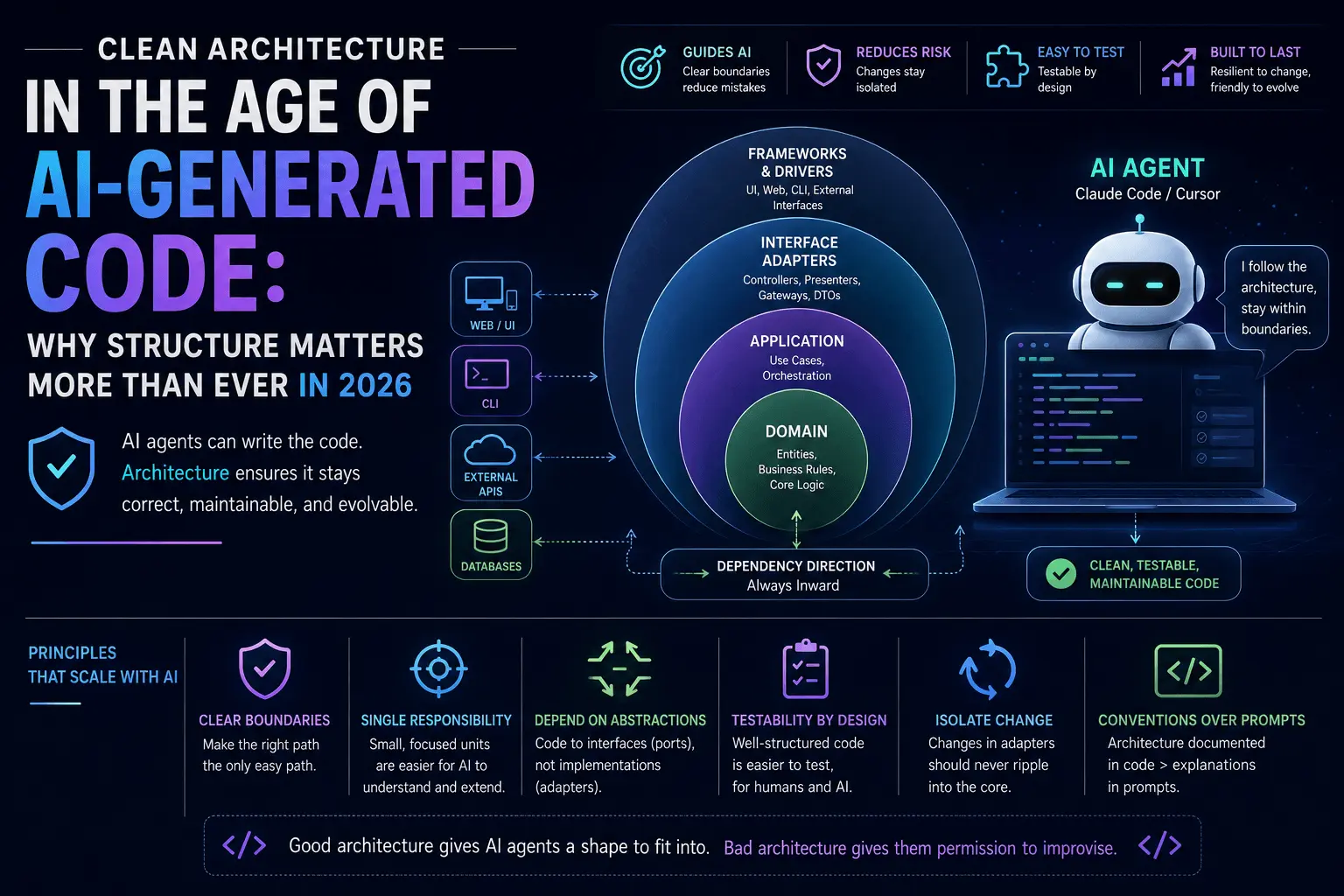
Clean Architecture in the Age of AI-Generated Code: Why Structure Matters More Than Ever in 2026
Why clean architecture, clear boundaries, and testability matter more, not less, when Claude Code and Cursor are writing large chunks of your codebase in 2026.
On this page
I used to think good architecture was a taste thing — something senior engineers cared about and everyone else tolerated. Then I started letting an AI agent write 70% of my code, and within two weeks I understood exactly why architecture existed in the first place. Not as a rulebook. As the only thing standing between “the agent shipped a working feature” and “the agent shipped a working feature that quietly wired the payment service directly into the UI layer.”
That’s the part nobody warns you about when they show you a demo of an AI agent building an app in ten minutes. The demo always happens on a green-field project with zero existing structure to violate. Your actual codebase isn’t that. It has boundaries, layers, and assumptions baked in from months of decisions — and an AI agent, left to its own devices, does not know or care about any of them unless the structure makes it impossible to ignore.
Why AI-generated code makes architecture matter more, not less
The instinctive assumption is that AI coding assistants reduce the need for architecture discipline — if the agent can just write the code, why bother with layers and interfaces? That’s backwards, and once you’ve watched it fail you don’t unsee it.
An AI agent optimizes for “does this pass the test / does this satisfy the prompt” in the moment it’s asked. It has no persistent opinion about where a database call belongs, whether a UI component should know about your billing provider, or whether a function you just asked it to write duplicates one three files away. A human engineer carries architectural context between tasks even when nobody wrote it down. An agent starts every session closer to zero. Multiply that by dozens of agent sessions across a sprint, and you get a codebase that accretes shortcuts the way a hard drive accretes fragmentation — not from malice, from the complete absence of a structural memory forcing consistency.
Clean architecture with AI generated code isn’t a nice-to-have anymore. It’s the mechanism that gives an agent a shape to conform to instead of a blank page to improvise on. Boundaries do for AI agents what type systems do for compilers: they turn an entire category of mistake into something that simply cannot compile, instead of something a reviewer has to notice by eye at 11pm.

The layering principles that actually hold up
Clean Architecture — Robert Martin’s version, and the similar Hexagonal / Ports-and-Adapters model before it — was never really about the specific circle diagram. It was about one rule: dependencies point inward, toward business logic, and never the other way around. Everything else is a consequence of that rule.
Here’s why that rule matters specifically for AI-assisted development:
- The domain layer has no idea an AI agent exists. Business rules — how a discount is calculated, what makes an order valid, when a subscription lapses — live in plain code with no framework imports, no HTTP client, no ORM. When an agent is asked to add a new discount rule, there is exactly one place it can go, because nothing else compiles.
- The application layer orchestrates, it doesn’t decide. Use cases coordinate domain objects and ports. If an agent tries to sneak business logic into a controller because that’s the fastest path to “green test,” a use-case layer with a clear contract makes that detour awkward instead of invisible.
- Adapters are where the mess is allowed to live. Database drivers, HTTP clients, third-party SDKs — all volatile, all fine to churn. This is the layer where you actually want an AI agent moving fast, because blast radius is contained by design.
- Interfaces (ports) are the contract an agent can’t quietly break. Define the interface once, by hand, with intent. Let the agent implement against it repeatedly. The interface is the spec; the implementation is disposable.
None of this is new. What’s new is the reason it matters: architecture used to be a discipline you enforced against your own future self, or against a slow-moving team. Now it’s a discipline you enforce against an extremely fast, extremely literal collaborator that will take the shortest path between two points unless the boundaries make the shortcut structurally unavailable.
Dependency direction as a guardrail, not a suggestion
Every time I’ve seen an agent produce a genuinely bad diff, the root cause traces back to a dependency pointing the wrong way — a domain object importing a UI framework, a use case reaching straight into a database client instead of going through a repository interface. The fix isn’t “tell the agent not to do that” in a prompt. Prompts are advisory. The fix is making the wrong-direction import fail the build, fail the lint rule, or simply not exist as an importable path in that layer’s folder. Static enforcement beats a polite request every time — for humans too, but especially for agents, which don’t accumulate guilt about violating a convention nobody encoded structurally.
Testability: the other half of the equation
Architecture and testability are the same conversation wearing two hats. A codebase with clear boundaries is testable almost by accident — pure domain logic with no I/O is trivial to unit test, use cases can be tested against fake adapters, and the messy real-world edges are isolated to a thin layer you test with integration tests, not everywhere.
This matters enormously for AI generated code review, because tests are the fastest signal an agent — and a human reviewer — has for “did this actually work” versus “does this look plausible.” A few patterns that hold up well in agent-heavy workflows:
- Write the test contract before the agent writes the implementation. If you can express “given X, the result must satisfy Y” as a test, hand the agent the test and the interface, not just a prose description. It narrows the solution space dramatically.
- Keep domain tests framework-free. No mocking a database, no spinning up a container — just objects and assertions. Fast tests get run constantly; slow tests get skipped, including by agents optimizing for “tests pass quickly.”
- Treat a growing mock/stub count as a smell, not a cost of doing business. If testing a “simple” change requires mocking six collaborators, that’s the architecture telling you a boundary is misplaced, not a hint to write a bigger mock.
- Let agents write tests, but review test intent, not just test pass/fail. An agent under pressure to make a test pass will sometimes weaken the assertion instead of fixing the code. Reading the diff on the test file is as important as reading the diff on the implementation.

A concrete before/after
Here’s the kind of diff an under-constrained agent produces when a UI component is allowed direct access to a repository, versus what happens when a port forces the boundary:
// Before: no boundary, agent takes the shortest path
function CheckoutButton({ cartId }: { cartId: string }) {
  const handleClick = async () => {
    const db = getDatabaseClient(); // direct DB access from a UI component
    const cart = await db.query("SELECT * FROM carts WHERE id = ?", [cartId]);
    await db.query("UPDATE carts SET status = 'checked_out' WHERE id = ?", [cartId]);
    await fetch("https://payments.example.com/charge", { method: "POST", body: JSON.stringify(cart) });
  };
  return <button onClick={handleClick}>Checkout</button>;
}

// After: a port the agent implements against, not around
interface CheckoutService {
  checkout(cartId: string): Promise<CheckoutResult>;
}

function CheckoutButton({ cartId, checkoutService }: { cartId: string; checkoutService: CheckoutService }) {
  const handleClick = () => checkoutService.checkout(cartId);
  return <button onClick={handleClick}>Checkout</button>;
}
The “before” version isn’t wrong because it’s poorly written — it’s wrong because nothing stopped the agent from reaching across three layers to satisfy one prompt. The “after” version is barely more code, but the UI component can no longer know a database or a payment endpoint exists. That constraint isn’t slower for the agent to work with. If anything it’s faster, because the agent has fewer decisions to make about where things go — the interface already answered that question.
Gotchas and edge cases
Over-layering is its own failure mode. Clean architecture applied dogmatically to a five-file CRUD app produces more ceremony than the problem needs, and agents will happily generate that ceremony because it “looks correct” — repositories wrapping repositories, use cases with one caller. Match the layering to the actual complexity of the domain, not to the diagram in the book.
Agents are excellent at following an established pattern and bad at inventing a good one. If your codebase has no consistent layering yet, don’t expect an agent to introduce one unprompted — it’ll mimic whatever’s already there, inconsistency included. The architecture has to exist, even loosely, before an agent can be expected to respect it.
Boundary violations compound faster with agents than with humans, simply because of throughput. A human making one architecture-violating shortcut a week is a slow leak. An agent doing several changes a day, each with a small chance of a boundary slip, turns into a codebase-wide erosion within a month if nothing structural is stopping it. This is the actual argument for investing in architecture now rather than later — the failure mode arrives faster than it used to.
Don’t mistake “the tests pass” for “the boundary held." An agent can satisfy a test suite while still violating a layering rule the tests never checked for. Lint rules and dependency-direction checks (import restrictions per folder, dependency-cruiser, ESLint boundaries plugins, or equivalent for your stack) catch what tests don’t.
FAQ
Does clean architecture slow down AI-assisted development? It slows down the first feature and speeds up every feature after that. The overhead is defining interfaces and layer boundaries once; the payoff is that an agent has a much smaller space of “technically valid but architecturally wrong” moves available to it on every subsequent task.
Which clean architecture principles matter most when AI writes the code? Dependency direction (inward toward domain logic) and interface-based boundaries between layers. Naming conventions and folder structure matter less than whether a wrong-direction import is even possible to write.
Can I enforce architecture boundaries automatically instead of relying on code review? Yes, and you should. Dependency-direction linting, import-restriction rules per folder, and architectural fitness tests (functions that scan the dependency graph and fail CI on a violation) turn “please don’t do that” into “that literally will not merge.” This matters more with agent-generated code because review bandwidth doesn’t scale with agent throughput.
Is this different from just writing good tests? Related but not the same. Tests catch behavioral regressions. Architecture boundaries catch structural ones — a change can pass every test and still put a dependency where it doesn’t belong. You need both, and testability is usually a side effect of good boundaries anyway.
Do SOLID principles still apply when an AI agent writes most of the implementation? More than ever, especially the Dependency Inversion Principle and Single Responsibility. They’re not style preferences here — they’re the mechanism that gives an agent a narrow, well-defined slot to implement code into, instead of an open field.
The actual shift
The honest version of this post isn’t “AI agents are bad at architecture, watch out.” It’s that architecture was always meant to constrain a fast-moving, imperfectly-informed contributor who takes the shortest path to “done” — that used to describe a junior engineer under deadline pressure, and it now also describes an agent under no pressure at all, just optimizing for the stated goal with zero institutional memory. The tool changed. The reason layers, boundaries, and interfaces exist did not.
If anything, 2026 is the year architecture stopped being the thing senior engineers argued about in design review and became the thing that determines whether an AI-assisted team ships a maintainable product or a fast-growing pile of code nobody, human or agent, can safely touch six months from now.