
What's Coming in C++26: Reflection, Contracts, and the Biggest Standard Update in Years
C++26 explained: static reflection, contracts (pre/post/contract_assert), #embed, pack indexing, and every major feature landing in the next C++ standard.
On this page
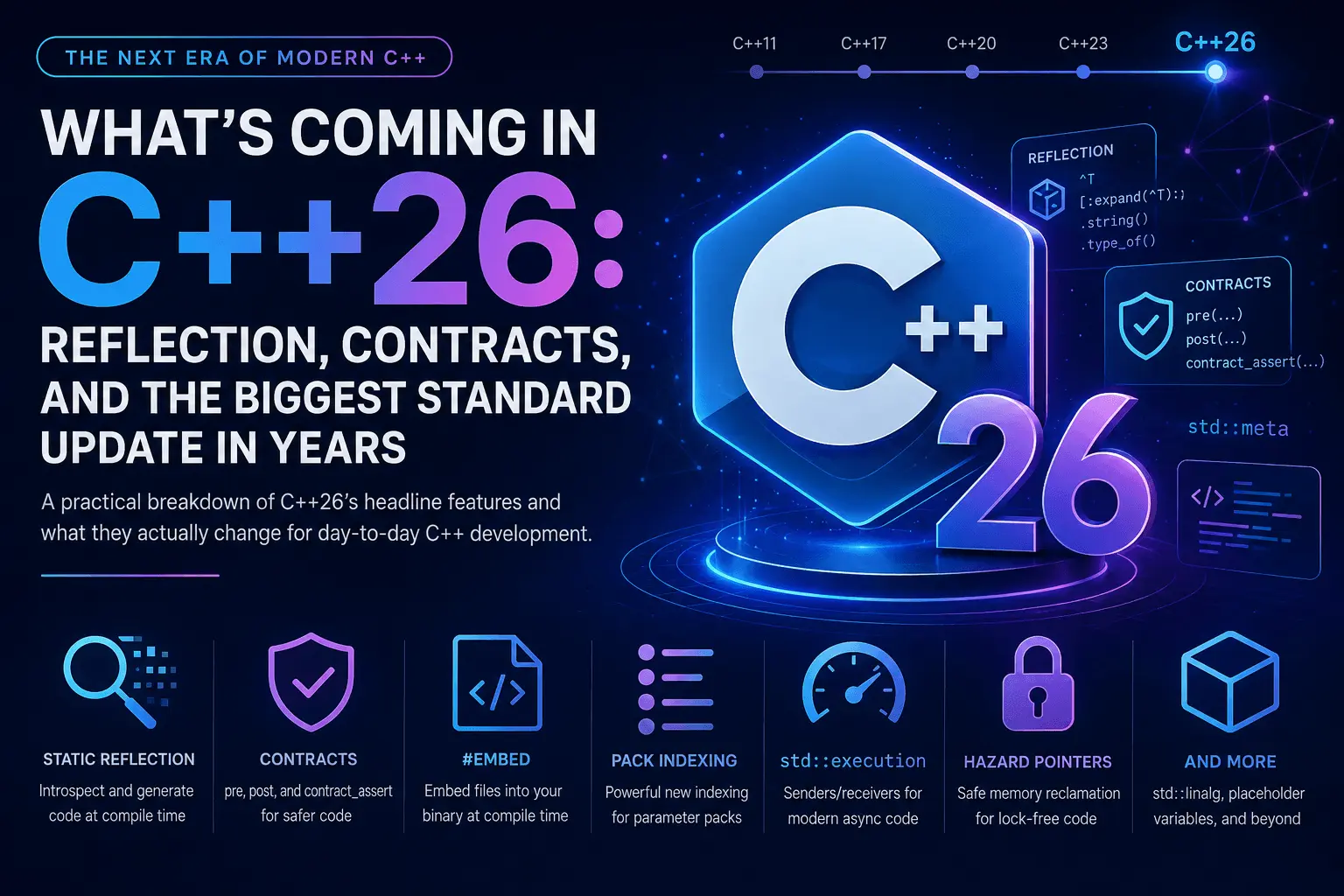
Every C++ standard since C++11 has been “the incremental one” — C++17 tidied things up, C++20 gave us concepts and coroutines, C++23 was mostly cleanup. C++26 is different. Two features landing in it — static reflection and contracts — have been on the wishlist since before C++11 shipped, and they’re finally real. I went through the accepted papers and current compiler support to figure out what actually changes for people writing C++ day to day, not just what sounds impressive on a slide.
Why C++26 Is the Biggest Standard Update in Years
Reflection alone has been discussed at committee meetings for over a decade. Every previous attempt stalled — too complex, too much compile-time overhead, not enough consensus on syntax. P2996 (the reflection proposal) finally got voted into the C++26 working draft, and it’s not a watered-down subset. It gives you a real ^ reflection operator, splicing with [:...:], and a std::meta namespace to introspect and generate code at compile time, no external tools required.
Contracts had an even rockier history — an earlier version was voted into C++20 and then pulled back out before release because the design had holes. This time (P2900) it went through several more rounds of scrutiny before landing in C++26 with pre, post, and contract_assert.
Add in a long tail of smaller but genuinely useful changes — #embed, pack indexing, placeholder variables, hazard pointers, std::linalg — and C++26 is shaping up to be the standard that finally changes how a lot of C++ code gets written, not just what libraries are available.

C++26 Reflection: What Static Reflection Actually Lets You Do
Static reflection means your code can inspect itself at compile time — enumerate a struct’s members, read their names and types, and generate new code based on that — without macros, without external code-generation tools, without __PRETTY_FUNCTION__ string-parsing hacks that half the “reflection” libraries in C++23 rely on.
Here’s the shape of it:
#include <meta>
#include <iostream>

template <typename T>
void print_fields(const T& obj) {
    // ^T reflects the type T into a compile-time value
    [:expand(^T):] >> [&]<auto member>() {
        std::cout << [:member:].string() << " = "
                   << obj.[:member:] << "\n";
    };
}

struct Point { int x; int y; };

int main() {
    print_fields(Point{3, 4}); // prints "x = 3" and "y = 4"
}
The ^ operator turns a type, a member, or a namespace into a reflection value you can pass around, inspect, and query at compile time — .string() gets you the name, .type_of() gets you the type, and so on through the std::meta API. The [:...:] splice operator turns a reflection value back into actual code — a type, an expression, a member access.
Why this matters in practice:
- Serialization libraries stop needing macros. JSON/binary serialization for structs currently requires
BOOST_FUSION_ADAPT_STRUCT-style boilerplate or a separate code-gen step. With reflection, a serializer can walk any struct’s members directly. - ORMs and reflection-based frameworks (think dependency injection, RPC stub generation) no longer need a build-time preprocessor pass.
- Compile-time introspection for debugging and logging — printing struct contents, enum-to-string, and back, without hand-writing a
switchfor every enum.
The catch: reflection metaprogramming has a real learning curve, closer to template metaprogramming than to runtime reflection in languages like Java or C#. It’s compile-time only — there’s no typeid-style runtime reflection here, and that’s intentional, since C++ still refuses to pay runtime cost for features you don’t use.

C++26 Contracts: pre, post, and contract_assert Explained
Contracts let you attach preconditions and postconditions directly to function declarations, checked (optionally) at runtime, instead of scattering assert() calls through function bodies or relying on comments nobody reads.
int divide(int a, int b)
    pre(b != 0)                 // precondition: checked before the body runs
    post(r: r == a / b) {       // postcondition: r is the return value
    return a / b;
}

void resize(std::vector<int>& v, std::size_t n) {
    contract_assert(n <= v.max_size()); // inline contract check, like assert() but standard
    v.resize(n);
}
Three pieces make up the feature:
pre(...)— a precondition attached to the function signature, evaluated before the body runs.post(name: ...)— a postcondition, with optional binding to the return value’s name, evaluated after the body runs but before control returns to the caller.contract_assert(...)— an inline assertion anywhere inside a function body, semantically similar toassert()but part of the language and subject to the same contract-checking build modes.
The build-mode model is what makes this actually useful in production instead of just being a fancier assert(): contracts can be compiled in three modes — off (zero overhead, contracts are pure documentation), enforce (violations call a contract-violation handler, typically abort or log-and-continue), and observe (log the violation but keep running). That means you can ship a pre/post-annotated public API, run the checked build in CI and staging, and flip to the zero-overhead build for the release binary — without touching a single line of the contract itself.
This is a genuinely different model from assert(), which is all-or-nothing based on NDEBUG. Contracts are part of the function’s public interface — they show up in the declaration, they document intent for every caller, and tooling (including static analyzers) can reason about them without executing anything.

Other Major C++26 Features You Should Know About
Reflection and contracts get the headlines, but several smaller changes will show up in ordinary code far sooner because they need less new mental model.
#embed — binary data at compile time. Embed a file’s raw bytes directly into your binary without an external tool converting it to a byte array first:
constexpr unsigned char logo[] = {
    #embed "logo.png"
};
No more xxd -i scripts in the build pipeline for shaders, icons, firmware blobs, or embedded fonts.
Pack indexing. You can finally index into a parameter pack directly instead of recursing through template specializations to peel off the Nth element:
template <typename... Ts>
auto first_two(Ts... args) {
    return std::pair{args...[0], args...[1]}; // pack[N] syntax
}
Placeholder variables (_). Multiple unused bindings in the same scope no longer need fake unique names:
auto [_, _, count] = parse_result(); // only `count` matters here
Erroneous behaviour for uninitialized reads. Reading an uninitialized int used to be undefined behaviour — a genuine source of security bugs and inconsistent-across-compilers results. C++26 makes it erroneous behaviour instead: implementations are required to give it a well-defined (if useless) value like zero, and are encouraged to diagnose it, instead of letting the optimizer assume it can’t happen and delete your bounds check.
std::execution (senders/receivers). A standard, composable model for asynchronous and parallel work — think of it as the standard library finally getting a real answer to “how do I structure async pipelines” instead of every framework inventing its own executor model.
Hazard pointers and RCU in the standard library. Lock-free concurrent data structure primitives (std::hazard_pointer, std::rcu_domain) move from “roll your own or pull in Folly” to “standard header.” This matters directly for anyone building high-throughput concurrent systems who currently depends on third-party libraries for memory reclamation.
std::linalg. A standard BLAS-based linear algebra library — matrix and vector operations with a standard API, useful for anyone currently hand-rolling this or depending on a vendor BLAS binding just for basic operations.
What Got Left Out of C++26
Worth being precise here, because it’s easy to find outdated blog posts claiming features that didn’t actually make the cut. Pattern matching (the inspect expression, P2688) — a switch-on-steroids that can destructure and match on types and structure — did not make it into C++26. It’s a strong candidate for C++29, but treat any code sample using inspect as speculative, not standard, until it actually lands.
Reflection-based metaclasses (compile-time class generation from a description, the more ambitious end of the original reflection vision) are also out of scope for C++26. What ships is the reflection primitives — ^, splicing, std::meta queries — not a full declarative metaclass system built on top of them. Expect libraries to build metaclass-like patterns on top of the primitives over the next few years, rather than the language shipping one directly.
How This Changes Day-to-Day C++ Development
For most working C++ developers, the honest near-term impact is smaller than the feature list suggests, and that’s fine — it’s normal for major standards to take years to show up in daily work:
- Compiler support lags the standard. Expect GCC and Clang to ship experimental reflection and contracts support behind flags well before it’s on by default, and MSVC typically trails both. Don’t plan production code around C++26 features until your toolchain’s release notes explicitly say “stable.”
- Library authors move first. Serialization, ORM, and RPC libraries will be the first real-world consumers of reflection — you’ll likely use reflection through a library’s API long before you write raw
^/[:...:]code yourself. - Contracts are the more immediately practical one. Once compiler support lands, contracts are a drop-in upgrade over
assert()-based interface documentation for any team already disciplined about pre/postcondition comments — the syntax is close enough to what people already write in doc comments that adoption friction should be low. - This is a multi-year rollout, the same way concepts (C++20) and coroutines (C++20) took a couple of years past ratification to become genuinely usable across GCC, Clang, and MSVC simultaneously.
Common Misconceptions About C++26
“Reflection means C++ now has runtime reflection like Java." No — it’s compile-time only. There’s no typeid-style runtime type inspection added here; the reflection value exists and is queried entirely during compilation.
“Contracts replace exceptions or error handling." No — contracts are about documenting and (optionally) checking assumptions about function interfaces, not about propagating recoverable errors. A contract violation is a programming bug being caught, not an expected runtime condition to handle and continue from.
“C++26 is already fully supported, I can use it today." Not yet, for the headline features. As of writing, reflection and contracts support is experimental at best across major compilers. Smaller features like #embed and pack indexing are further along.
“Pattern matching is in C++26." It isn’t — see above. This is the single most common inaccuracy floating around in “C++26 preview” content right now.
FAQ
When is C++26 officially released? The ISO C++ committee is targeting ratification in 2026, following the usual cadence of a new standard roughly every three years since C++11. Final publication timing depends on the remaining committee meetings and national body ballots.
Do I need to learn reflection to use C++26 effectively? Not immediately. Most developers will consume reflection through libraries (serializers, ORMs) rather than writing raw reflection code. Learning the primitives becomes worthwhile once you’re building or maintaining that kind of library-level infrastructure.
Are contracts a replacement for unit tests? No. Contracts check interface assumptions at the boundary of a function call — they complement tests, they don’t replace them. A passing contract tells you the function’s stated assumptions held; it says nothing about whether the function’s actual behavior is correct for a given input.
Which compiler should I use to try C++26 features today? Recent Clang and GCC trunk builds have the most active experimental work on reflection and contracts — check each compiler’s C++26 feature-support table before assuming a specific paper is implemented, since support lands paper-by-paper, not all at once.
Is C++26 a bigger change than C++11 was?
In terms of how fundamentally reflection changes what’s possible without external tooling, it’s comparable — C++11 gave the language move semantics, lambdas, and auto; C++26 gives it a standard way to introspect and generate code at compile time. Both are the kind of change that reshapes idioms across the ecosystem over the following decade, not just the release itself.
Closing thought
C++26 is the first standard in a long time where the headline features aren’t quality-of-life syntax sugar — they’re capabilities the language genuinely didn’t have before, filling gaps that libraries and macros have been papering over for decades. It’ll take a couple of years past ratification for compiler support and library ecosystems to catch up, same as every major standard before it. But reflection and contracts are worth understanding now, before they show up in a library you depend on and you’re debugging ^T syntax with no context for what it means.