
Rust for Web Backends in 2026: Axum vs Actix vs Rocket
Axum vs Actix-web vs Rocket compared for 2026 — performance, ergonomics, async runtime choices, and which Rust web framework to pick for your next backend.
On this page
I spent the last few months building three small but real backends — a webhook relay, an internal admin API, and a rate-limited proxy — each in a different Rust web framework, on purpose. Not a toy benchmark, actual services with auth, database pools, and traffic. The goal was simple: figure out which Rust web framework I’d actually reach for by default in 2026, and which ones only make sense in specific situations. This post is that answer, backed by what broke, what didn’t, and how much code each one asked of me.
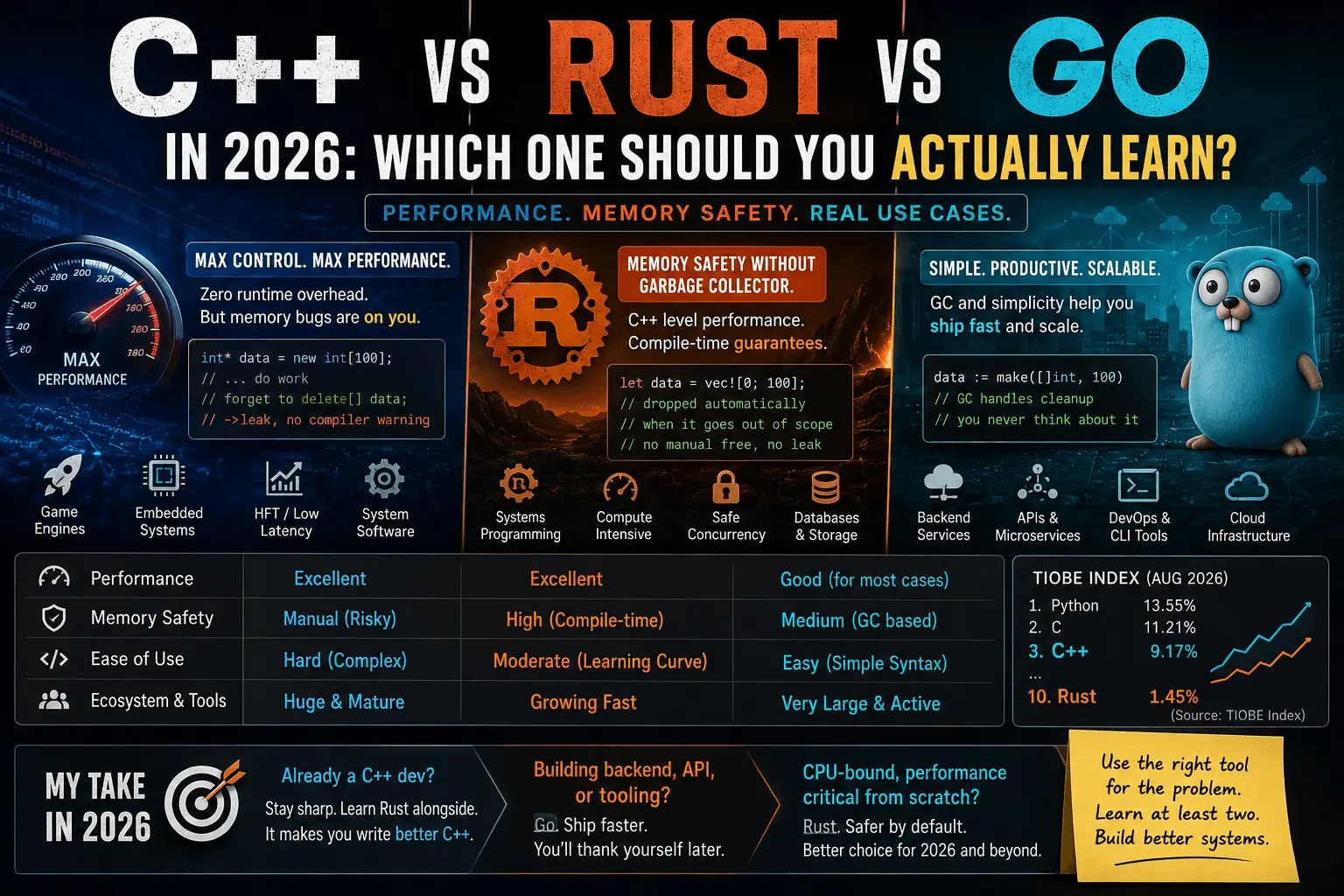
This isn’t a “Rust vs Go vs C++” post — I already wrote that comparison at the language level. This one stays inside Rust and answers the narrower, more useful question: once you’ve decided to build a backend in Rust, which framework do you reach for — Axum, Actix-web, or Rocket?
Why the Rust web framework question matters more in 2026
Three years ago, picking a Rust web framework meant picking between “fast but rough” and “batteries-included but slower.” That gap has mostly closed. Axum has become the de facto default for new projects backed by the Tokio team itself, Actix-web keeps winning raw throughput benchmarks and just crossed another major stability milestone, and Rocket has quietly become the most pleasant framework to write in if you don’t need to squeeze out the last 10% of performance.
Rust backends have also stopped being a niche choice. Discord, Cloudflare, AWS (Firecracker, S3’s control plane components), and a growing list of fintech and infra companies run production HTTP services in Rust today — not as an experiment, but because they need predictable latency under load without a garbage collector pause showing up in their p99. If you’re evaluating a Rust web framework for backend work in 2026, you’re not making a bet on an immature ecosystem anymore. You’re picking between three mature, opinionated options.
The shared foundation: Tokio and async Rust
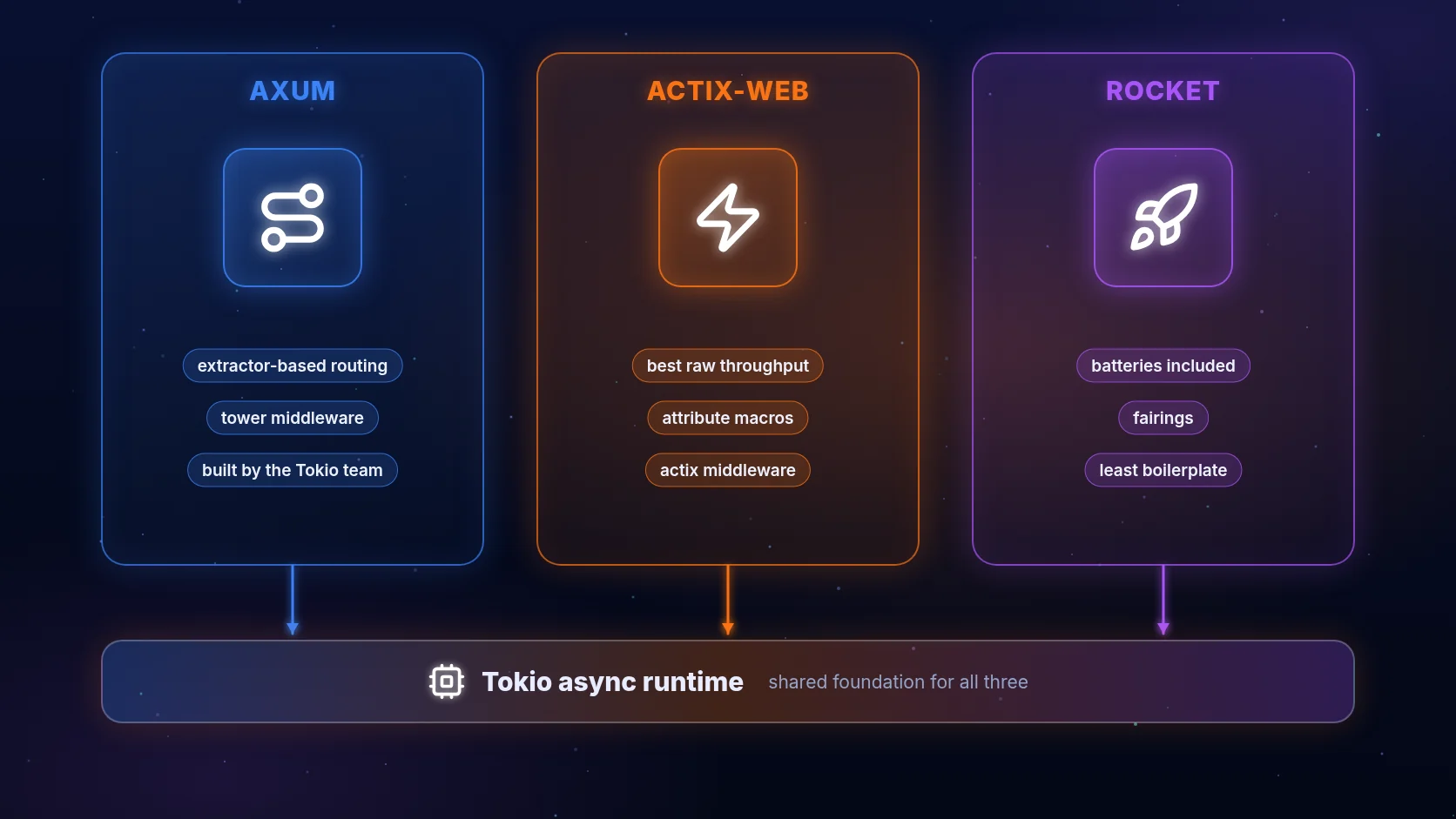
Before comparing the three, it’s worth being precise about what they share. Axum and Actix-web both run on Tokio, Rust’s dominant async runtime — Rocket added optional Tokio support a while back too, so all three now sit on the same async foundation rather than competing runtimes. That matters because it means the actual I/O layer — epoll on Linux, IOCP on Windows — is effectively identical across all three. The differences you feel are almost entirely in the framework layer on top: routing, extractors, middleware, and how much the framework does for you versus how much you wire up yourself.
#[tokio::main]
async fn main() {
    // every framework in this post eventually calls something like this
    // the differences are what happens between here and your handler
}
That shared runtime also means benchmarks between them are closer than framework marketing pages suggest. The days of one Rust framework being 3x faster than another are mostly over — you’re now choosing based on ergonomics, ecosystem fit, and how the framework wants you to structure your app, not raw requests-per-second.
Axum: the Tokio team’s own answer
Axum is built and maintained by the Tokio project itself, which is the single biggest reason it’s become the default recommendation in 2026. It leans entirely on the tower ecosystem for middleware — meaning anything built as a tower::Service (rate limiting, tracing, compression, retries) drops into an Axum app with almost no glue code.
use axum::{routing::get, Router, extract::Path};

async fn get_user(Path(id): Path<u32>) -> String {
    format!("user {id}")
}

#[tokio::main]
async fn main() {
    let app = Router::new().route("/users/:id", get(get_user));
    let listener = tokio::net::TcpListener::bind("0.0.0.0:3000").await.unwrap();
    axum::serve(listener, app).await.unwrap();
}
What stood out building the webhook relay in Axum: extractors are the whole design philosophy. Instead of pulling data out of a generic Request object by hand, your handler’s function signature declares what it needs — Path<u32>, Json<Payload>, State<AppState> — and Axum wires it up or returns a typed error automatically if the request doesn’t match. It reads almost like dependency injection, except it’s checked at compile time.
Where Axum wins: no macros for routing (unlike Rocket’s attribute macros or Actix’s route macros), first-class tower middleware reuse, and it’s the framework most likely to get new features first since it ships from the same team as the runtime it depends on. Where it costs you: because it’s minimal by design, things like sessions, CSRF protection, and templating are BYO via crates rather than built in — you assemble more of the stack yourself compared to Rocket.
Actix-web: still the raw performance leader
Actix-web has consistently topped the TechEmpower framework benchmarks for years, and that hasn’t changed in 2026. It predates the async/await stabilization in Rust and was originally built on the actor model (hence the name), though most people today use it purely as an async web framework without touching actors directly.
use actix_web::{get, web, App, HttpServer, Responder};

#[get("/users/{id}")]
async fn get_user(id: web::Path<u32>) -> impl Responder {
    format!("user {id}")
}

#[actix_web::main]
async fn main() -> std::io::Result<()> {
    HttpServer::new(|| App::new().service(get_user))
        .bind(("0.0.0.0", 8080))?
        .run()
        .await
}
Running the rate-limited proxy on Actix-web, the thing that actually mattered in production wasn’t the benchmark chart — it was HttpServer’s built-in worker-per-core model. Actix-web spins up a configurable number of worker threads, each running its own Tokio runtime instance, and load-balances incoming connections across them automatically. For a CPU-bound proxy doing header rewriting and rate-limit checks on every request, that model squeezed out noticeably better throughput under sustained load than a naive single-runtime setup.
Where Actix-web wins: still the fastest of the three in most raw-throughput benchmarks, mature middleware ecosystem (actix-web has been production-grade the longest of the three), and the worker-per-core model is genuinely useful for CPU-heavy request handling. Where it costs you: the API surface is bigger and the actor-model history still shows up in some corners of the docs, so the learning curve is steeper than Axum’s, especially for anyone coming from a simpler framework in another language.
Rocket: the framework that makes Rust feel like batteries-included
Rocket was the framework that convinced a lot of people Rust backends didn’t have to be painful, back before Axum existed. It leans hard on attribute macros and procedural code generation to make route declarations read almost like a config file.
#[macro_use] extern crate rocket;

#[get("/users/<id>")]
fn get_user(id: u32) -> String {
    format!("user {id}")
}

#[launch]
fn rocket() -> _ {
    rocket::build().mount("/", routes![get_user])
}
Building the internal admin API in Rocket, the difference that actually mattered day to day was request guards — Rocket’s mechanism for validating and extracting data (auth headers, cookies, form data) before a handler even runs, with compile-time checked types. Combined with built-in support for JSON, forms, file uploads, and a template engine out of the box, Rocket got that admin API from zero to a working CRUD interface faster than either of the other two frameworks did for equivalent features, mostly because less had to be pulled in from third-party crates.
Where Rocket wins: the most complete “batteries included” experience of the three — templating, cookies, CSRF-adjacent guards, and form handling all ship in the box. It’s also, subjectively, the nicest framework to read code in, since the macros keep route definitions compact. Where it costs you: it trails Axum and Actix-web slightly on raw benchmark numbers, and heavier reliance on macros means error messages can be less obvious to a newcomer than Axum’s plain-function-signature approach.
Axum vs Actix vs Rocket: side-by-side comparison
| Axum | Actix-web | Rocket | |
|---|---|---|---|
| Async runtime | Tokio (native) | Tokio (native) | Tokio (optional, now default) |
| Routing style | Function signatures + extractors | Attribute macros + App::service |
Attribute macros |
| Middleware | tower::Service ecosystem |
Actix middleware trait | Fairings |
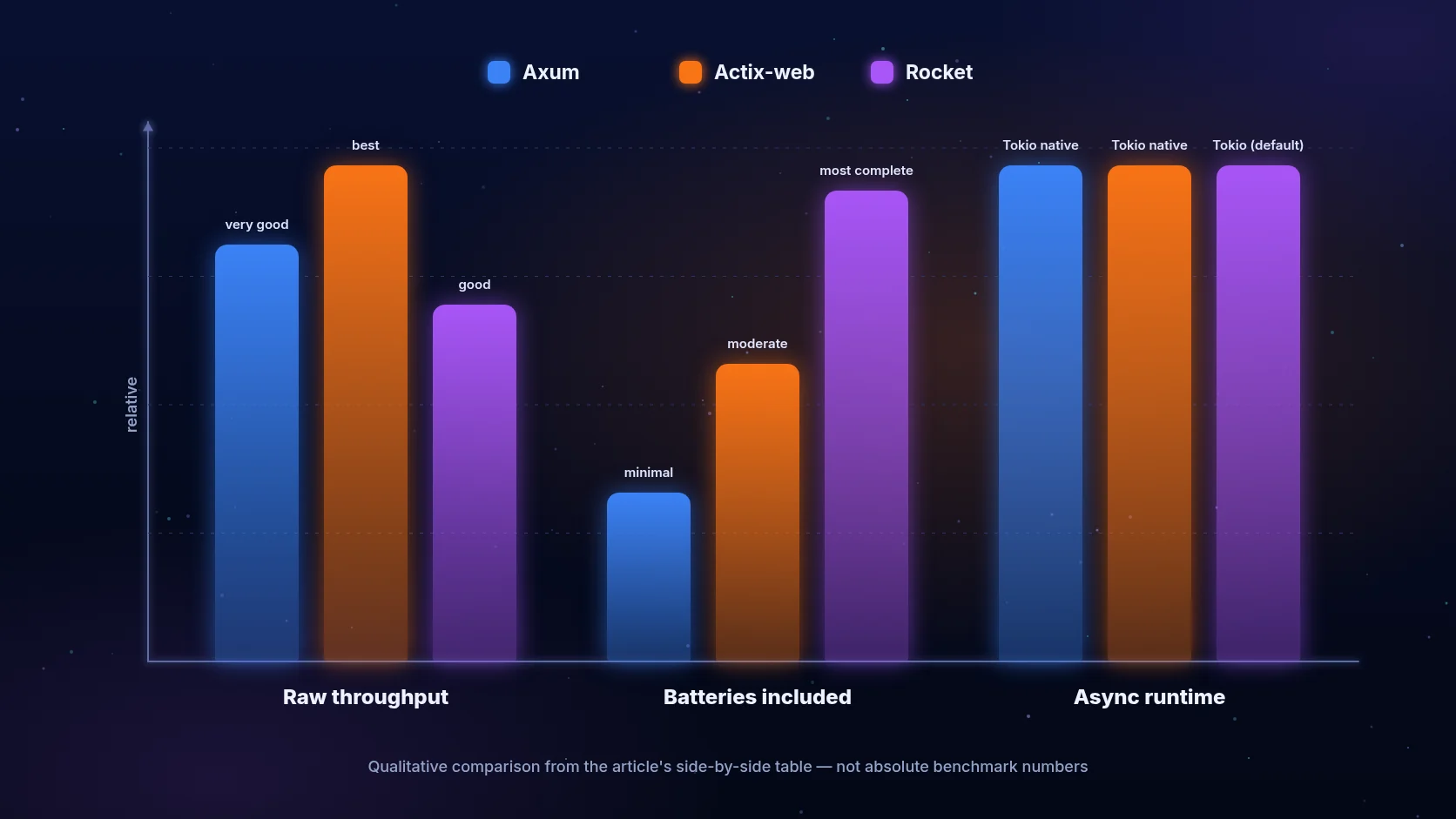
| Raw throughput | Very good | Best of the three in most benchmarks | Good, slightly behind the other two |
| Batteries included | Minimal, compose via crates | Moderate | Most complete out of the box |
| Backed by | Tokio project | Independent maintainers | Independent maintainers |
| Best for | New projects, teams already using tower |
High-throughput services, CPU-bound request handling | Fast prototyping, teams that want less boilerplate |
Gotchas and edge cases across all three
A few things I only ran into once real traffic and real deployments were involved, not in a hello-world demo:
Blocking code kills all three the same way. None of this framework-level ergonomics matters if you call a blocking database driver or a synchronous std::fs read inside an async handler. All three frameworks will happily let you stall a worker thread and tank throughput — you need spawn_blocking (Tokio) or an async driver (sqlx, tokio-postgres) regardless of which framework you picked. This bug looks identical in Axum, Actix, and Rocket, and it’s the single most common cause of “why is my Rust API suddenly slow” that has nothing to do with the framework at all.
Compile times are a real cost, and they scale differently. Actix-web’s heavier macro and generic-trait usage tends to produce the slowest incremental compile times of the three in larger codebases. Axum’s simpler trait bounds generally compile faster. If your team does a lot of iterative local development, this is worth testing on your actual codebase size before committing — it compounds over months.
Extractor/guard ordering matters more than it looks. In Axum, extractor order in a handler’s arguments affects which errors get generated first; in Rocket, request guard failure ordering can silently change which route candidate wins when multiple routes could match. Neither is a bug, but both bit me in ways that only showed up once I had overlapping routes with different auth requirements.
Error handling philosophy differs sharply. Axum expects you to implement IntoResponse for your own error types and lean on the type system. Actix-web has a more centralized ResponseError trait with more built-in conversions. Rocket uses Responder plus catcher functions for error pages. None is objectively better, but switching between them mid-project (which I did, on purpose, for this comparison) meant re-learning the idiomatic error pattern each time.
Frequently asked questions
Is Axum faster than Actix-web? In most published benchmarks, Actix-web still edges out Axum on raw requests-per-second, though the gap has narrowed significantly as Axum has matured. For the overwhelming majority of real-world backends, the difference is not the bottleneck — your database, network, or business logic will dominate latency long before the framework’s per-request overhead does.
Should I use Rocket for a production API in 2026? Yes, if it fits your team — Rocket has been stable and production-ready for years, and companies do run it in production. The main reason people default to Axum instead isn’t stability, it’s ecosystem gravity: more recent tutorials, more tower middleware compatibility, and Tokio-team backing.
Do I need to know Actix’s actor model to use Actix-web? No. Modern Actix-web usage is almost entirely async/await based. The actor system (actix crate, separate from actix-web) still exists and is genuinely useful for certain stateful-service patterns, but you can build and ship a complete Actix-web API without ever touching an actor.
Can I mix Tokio-based crates across all three frameworks? Yes — since all three now run on Tokio, async database drivers, HTTP clients, and other Tokio-based crates work the same way regardless of which framework sits on top. This is a big part of why the “which framework” decision has gotten lower-stakes over time; you’re not locking yourself out of the ecosystem either way.
Which one should I pick for a new project right now? If you’re starting fresh with no strong opinion, Axum is the safest default in 2026 — it’s what most new tutorials teach, it has the best tower middleware compatibility, and it’s maintained by the same team as the runtime it sits on. Reach for Actix-web specifically when you’ve profiled a bottleneck and need the worker-per-core throughput model. Reach for Rocket when developer velocity and built-in features matter more than shaving off the last few percent of latency.
Closing thought
None of these three frameworks is wrong, and that’s actually the interesting part of where Rust’s web ecosystem landed in 2026 — the competition stopped being about who’s “production ready” and became about fit. I’d still start a greenfield project in Axum by default, reach for Actix-web the moment a profiler tells me I need the worker-per-core model, and recommend Rocket to anyone who wants to move fast without duct-taping five crates together for basic features. The real win for Rust backends isn’t any single framework — it’s that all three are boring, stable, well-documented choices now, which is exactly what you want from infrastructure you’re betting a production service on.