C++ vs Rust vs Go in 2026: Which One Should You Actually Learn?
Every few months someone asks me the same question: “should I learn Rust or just stick with C++?” Lately Go gets thrown into that question too. I’ve written a lot of C++, poked at Rust, and shipped small things in Go — so here’s my honest 2026 take, backed by what’s actually happening in the ecosystem right now, not vibes.
Why this comparison actually matters in 2026
This isn’t an academic exercise. Every year the “systems programming language” conversation gets louder, and every year half the internet declares C++ dead and the other half declares Rust a fad. Neither is true, and the data backs that up.
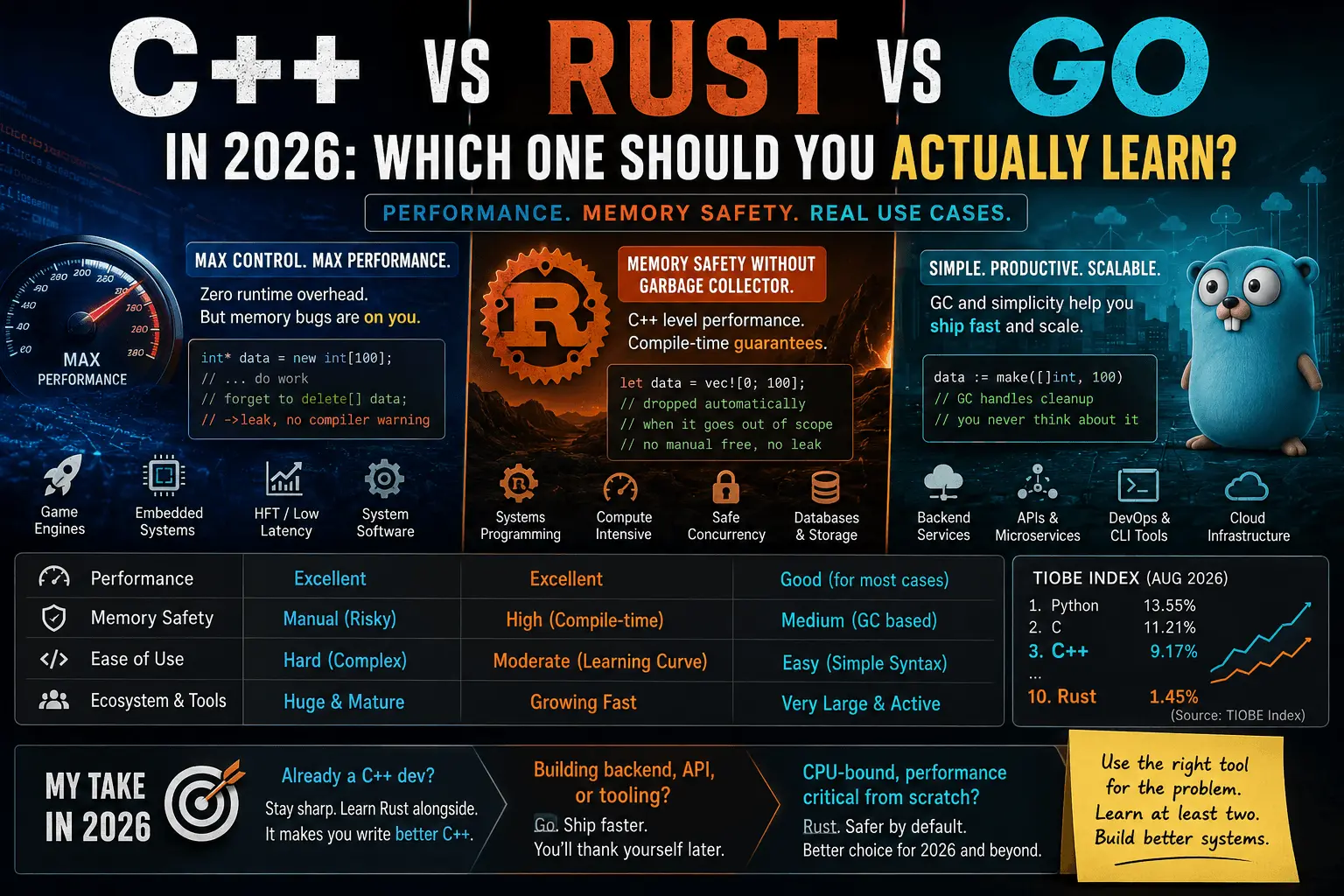
C++ is still No. 3 on the TIOBE index this month, right behind Python and C. It’s not going anywhere — every game engine, every embedded system, every latency-critical trading desk still runs on it. Rust entered the TIOBE top 10 for the first time in July and held No. 10 in August, rating climbing from 1.34% to 1.45%. Small number, but the trend line matters more than the position — it’s the fastest a “safety-first” systems language has ever climbed that index.
Go doesn’t chase the same spot on that chart, and it doesn’t need to — it won a different fight entirely: backend services, APIs, infra tooling. Kubernetes, Docker, Terraform, most of the modern cloud-native stack — that’s Go’s home turf, and it built it almost from scratch in a decade.
So the real question in 2026 isn’t “which language wins.” It’s “which one do I reach for, and why does it matter enough to spend six months getting good at it.” That’s what this post actually answers.

C++ in 2026: still the default for raw control
C++ gives you total control and zero mandatory runtime overhead. No garbage collector, no runtime checks unless you opt into them, direct access to memory layout, and four decades of compiler optimization work behind it. That’s exactly why it still runs game engines (Unreal, most AAA studios), embedded firmware, HFT systems, and huge chunks of browser and OS internals — Chrome, most of Windows, large parts of Linux driver code, the works.
The cost of that control is that memory management is entirely on you.
int* data = new int[100];
// ... forget to delete[] data; -> leak, no compiler warning
// or worse: another thread frees it first -> use-after-free
No compiler in the world will stop that leak from shipping. Modern C++ (C++20/23) gives you smart pointers, RAII, and static analyzers that catch a lot of this — but none of it is enforced by the language itself. Discipline and code review are still doing a huge share of the safety work in 2026, which is exactly why memory-safety CVEs in C++ codebases keep showing up in security audits at Google, Microsoft, and the NSA’s own advisories.
Tooling and ecosystem: mature beyond anything else on this list — CMake, vcpkg, Conan, decades of libraries, every major IDE has first-class support. Learning curve: steep, and it doesn’t flatten — undefined behavior, template metaprogramming, and manual memory management keep teaching you new ways to shoot yourself in the foot for years.
Rust in 2026: memory safety without giving up performance
Rust’s whole pitch is that you shouldn’t have to choose between “fast” and “safe.” The ownership and borrowing system is enforced entirely at compile time — there’s no garbage collector, no runtime tax, just a stricter compiler that refuses to build code with dangling references, data races, or double frees.
let data = vec![0; 100];
// dropped automatically when it goes out of scope — no manual free, no leak
// try to use it from two threads without synchronization -> compile error, not a 3am page
That last line is the entire value proposition. The bug classes that cause the majority of C++ CVEs — use-after-free, buffer overflows, data races — are, for the most part, structurally impossible in safe Rust. You still have unsafe blocks for the rare case you need raw pointer access, but they’re opt-in and grep-able, which means code review can actually focus attention where it’s warranted.
Real production use in 2026: parts of the Linux kernel now accept Rust drivers, Microsoft rewrote chunks of Windows low-level components in it, Discord’s backend infra, AWS’s Firecracker VMM, Cloudflare’s edge networking, and Google now ships Rust in Android’s low-level stack alongside C++. This isn’t experimental anymore — it’s production infrastructure at companies that cannot afford downtime.
Tooling and ecosystem: Cargo is genuinely one of the best package managers/build tools of any language, full stop — dependency resolution, testing, formatting, linting all built in. The library ecosystem (crates.io) has matured enormously but still has gaps compared to C++’s forty-year head start. Learning curve: the borrow checker fights you hard for the first few months — that’s not a bug, it’s the entire point, but it does mean Rust takes longer to feel productive in than Go, and often longer than C++ for someone who already knows systems programming.
Go in 2026: simplicity and speed of shipping
Go trades some raw performance for a garbage collector and deliberately minimal syntax. It was designed at Google specifically to solve a people problem — large teams, high turnover, needing new engineers productive fast on shared codebases. It succeeded at that better than almost any language ever has.
data := make([]int, 100)
// GC handles cleanup — you never think about it
// data races on shared state are still possible -> go run -race catches them, but only at runtime
That last comment matters: Go is memory-safe in the sense that you can’t corrupt memory or get a dangling pointer, but it does not prevent data races the way Rust’s borrow checker does at compile time — the race detector is a runtime tool, not a compile-time guarantee. That’s a meaningfully different safety model, and it’s worth being precise about it instead of lumping Go and Rust together as “both memory safe.”
Real production use: essentially the entire modern cloud-native stack — Kubernetes, Docker, Terraform, Prometheus, etcd — plus huge swaths of backend services at Uber, Twitch, Cloudflare (for control-plane tooling specifically, distinct from their Rust data-plane work), and Google’s own internal infrastructure.
Tooling and ecosystem: go build, go test, go fmt, go mod — batteries included, minimal bikeshedding, fast compile times even on huge codebases. Learning curve: by far the easiest of the three. You can be reasonably productive in a week. The tradeoff is that Go’s simplicity is also a ceiling — no generics-heavy abstractions (though generics did land), no manual memory control, and GC pauses that, while short, are non-zero and non-negotiable.

Head-to-head: what the benchmarks actually say
I’m not going to hand you fabricated precise numbers pretending to be a peer-reviewed paper — anyone doing that from memory is making it up. What I can tell you is the shape of the results that shows up consistently across independent benchmark suites (Techempower, language shootout-style comparisons, and internal engineering blog posts from companies that migrated production services):
- C++ vs Rust on raw CPU-bound compute (parsers, codecs, numeric kernels): these two trade blows depending on workload and how aggressively the code is tuned. Rust’s LLVM backend gets it into the same performance tier as well-written modern C++, generally within single-digit percentage points either way. The real difference isn’t speed — it’s that Rust removes an entire category of runtime bugs that in C++ depend purely on programmer discipline.
- Rust vs Go on CPU-bound work: Rust pulls ahead consistently, often by a wide margin (multiples, not percentages) on tight loops, heavy allocation, and anything compute-bound rather than I/O-bound. This is almost entirely explained by Go’s GC overhead and less aggressive inlining/optimization compared to LLVM.
- Go vs the other two on I/O-bound, concurrent workloads (typical web services, API gateways): the gap shrinks dramatically or disappears. Once your bottleneck is the network or the database, the language’s compute performance stops mattering, and Go’s goroutine model plus low cognitive overhead wins on developer velocity.
- Memory footprint: C++ and Rust both give you precise control and predictable low memory use. Go’s GC needs headroom — production Go services typically run with noticeably higher baseline memory to give the collector room to work, which matters at container-density scale.
The honest summary: Rust and C++ are in the same performance league; Go is in a different one for CPU-bound work, but frequently irrelevant for I/O-bound work.
The decision framework: which language for which job
Rather than a single winner, here’s how I’d map real jobs to languages, because that’s the actual decision most people are making:
- Embedded / firmware / bare-metal: still overwhelmingly C++, with Rust rapidly gaining ground where the toolchain and hardware support exist (Rust’s embedded-hal ecosystem is real but younger). If your target chip’s SDK is C/C++ only, that decides it for you.
- Network services / APIs / infra tooling: Go, almost by default. Fast to write, fast to onboard new engineers, more than fast enough once I/O dominates.
- Performance-critical compute (game engines, codecs, physics, databases, compilers): Rust is the most defensible new choice in 2026; C++ remains completely valid if you already have the codebase, libraries, and team expertise.
- Existing large C++ codebase: don’t panic-rewrite. Rust interop via FFI at the edges (new modules, new services) is the realistic 2026 migration pattern — see what Android and parts of Windows are doing — not a big-bang rewrite.
- Security-critical systems handling untrusted input (parsers, network-facing daemons, browser components): Rust’s compile-time guarantees earn their keep hardest exactly here, which is why browser vendors and OS kernels are the ones adopting it fastest.
- A team that needs to onboard junior engineers fast and ship this quarter: Go, without much debate.
Common misconceptions worth clearing up
“Rust makes your code bug-free." No — it eliminates specific bug classes (memory safety, data races in safe code). Logic bugs, deadlocks (in some forms), and incorrect algorithms are entirely still possible. Memory safety isn’t correctness.
“C++ is legacy and dying." The TIOBE ranking alone disproves this — it’s still #3 globally, and the amount of new C++ being written in game development, HFT, and embedded work in 2026 is not shrinking. “Old” and “declining” are not the same thing.
“Go isn’t a real systems language." Depends on your definition. Go was never designed to compete with C++/Rust for kernel-level or embedded work — no manual memory control, a mandatory runtime, GC pauses. But it’s absolutely a systems language in the “build the systems that run your infrastructure” sense — just not the “run without an OS” sense.
“You only need to know one of these." Increasingly false. Mixed codebases — Go for the network layer, Rust or C++ for the compute-intensive core — are now common enough that being fluent in at least two is a realistic expectation for senior systems roles.
FAQ
Is Rust replacing C++? Not wholesale, and probably never entirely. Rust is winning new projects and edge components in existing C++ systems (Linux kernel drivers, Windows components, Android internals), but the installed base of C++ — game engines, embedded firmware, decades of financial and scientific software — is too large and too stable to be “replaced” in any near-term sense. Think steady displacement at the margins, not a takeover.
Is Go good for systems programming? For network services, infrastructure tooling, and control-plane systems — yes, demonstrably, look at Kubernetes and Docker. For kernel-level, embedded, or hard-real-time systems — no, it was never built for that, and the GC and runtime rule it out.
Do I need to learn all three? No, but knowing the tradeoffs of all three well enough to read code in each is increasingly the baseline for senior systems and infra roles. Depth in one, working fluency in a second, is a realistic goal.
Which one should a beginner start with in 2026? If you’re new to programming entirely, Go’s simplicity makes it the gentlest on-ramp to real, production-shippable systems work. If you already know a lower-level language and want to go deeper into how memory actually works, learn C++ first, then Rust — the contrast is what makes Rust’s ownership model click.
Closing thought
None of these languages are going away. The real skill in 2026 isn’t picking a winner — it’s knowing which one to reach for on a given problem, and being able to read at least two of the three well enough to work in a mixed codebase, because increasingly that’s exactly what you’ll be handed.