
Modern C++ Memory Management in 2026: unique_ptr, shared_ptr, and When You Still Need Raw Pointers
A practical 2026 guide to modern C++ memory management — unique_ptr, shared_ptr, weak_ptr, RAII, and move semantics, plus when raw pointers still make sense.

On this page
I still see pull requests in 2026 with a raw new sitting in a constructor and no matching delete anywhere in sight. Nobody’s being careless — the codebase just grew organically and smart pointers never made it into the house style. So here’s the practical version of “modern C++ memory management” I wish someone had handed me years ago: not a language-lawyer tour of the standard, just what to reach for, when, and why the alternative bites you eventually.
Why Memory Management Still Matters in Modern C++
C++ doesn’t have a garbage collector, and in 2026 that’s still a deliberate design choice, not a gap waiting to be filled. You get deterministic destruction, zero runtime overhead when you don’t need it, and full control over layout and lifetime — which is exactly why C++ still runs game engines, trading systems, and embedded firmware where a GC pause is unacceptable.
The tradeoff is that every allocation needs an owner, and every owner needs a plan for release. Miss that plan once and you get a leak. Get the ownership model wrong under concurrency and you get a use-after-free that only shows up in production, three months later, under load. Static analyzers and sanitizers (ASan, UBSan) catch a lot of this in CI now, but they’re a safety net, not a substitute for a codebase where ownership is obvious from the type signature.
That’s the actual point of modern smart pointers: they turn “who owns this and when does it die” from a comment or a mental note into something the compiler enforces.
RAII: The Idea Everything Else Is Built On
RAII — Resource Acquisition Is Initialization — is the one concept that makes all of this work. Tie a resource’s lifetime to a stack-allocated object’s lifetime. Acquire the resource in the constructor, release it in the destructor. When the object goes out of scope — normal return, early return, or an exception unwinding the stack — the destructor runs and the resource is freed. No finally block, no manual cleanup path to forget.
class FileHandle {
public:
    explicit FileHandle(const char* path) : fp_(std::fopen(path, "r")) {
        if (!fp_) throw std::runtime_error("failed to open file");
    }
    ~FileHandle() { if (fp_) std::fclose(fp_); }

    // disable copy, or implement it properly — see move semantics below
    FileHandle(const FileHandle&) = delete;
    FileHandle& operator=(const FileHandle&) = delete;

private:
    std::FILE* fp_;
};
Smart pointers are just RAII applied specifically to heap-allocated objects. Once you internalize RAII, unique_ptr and shared_ptr stop looking like magic and start looking like the obvious application of a pattern you’d write yourself anyway.
unique_ptr: Your Default Choice for Heap Ownership
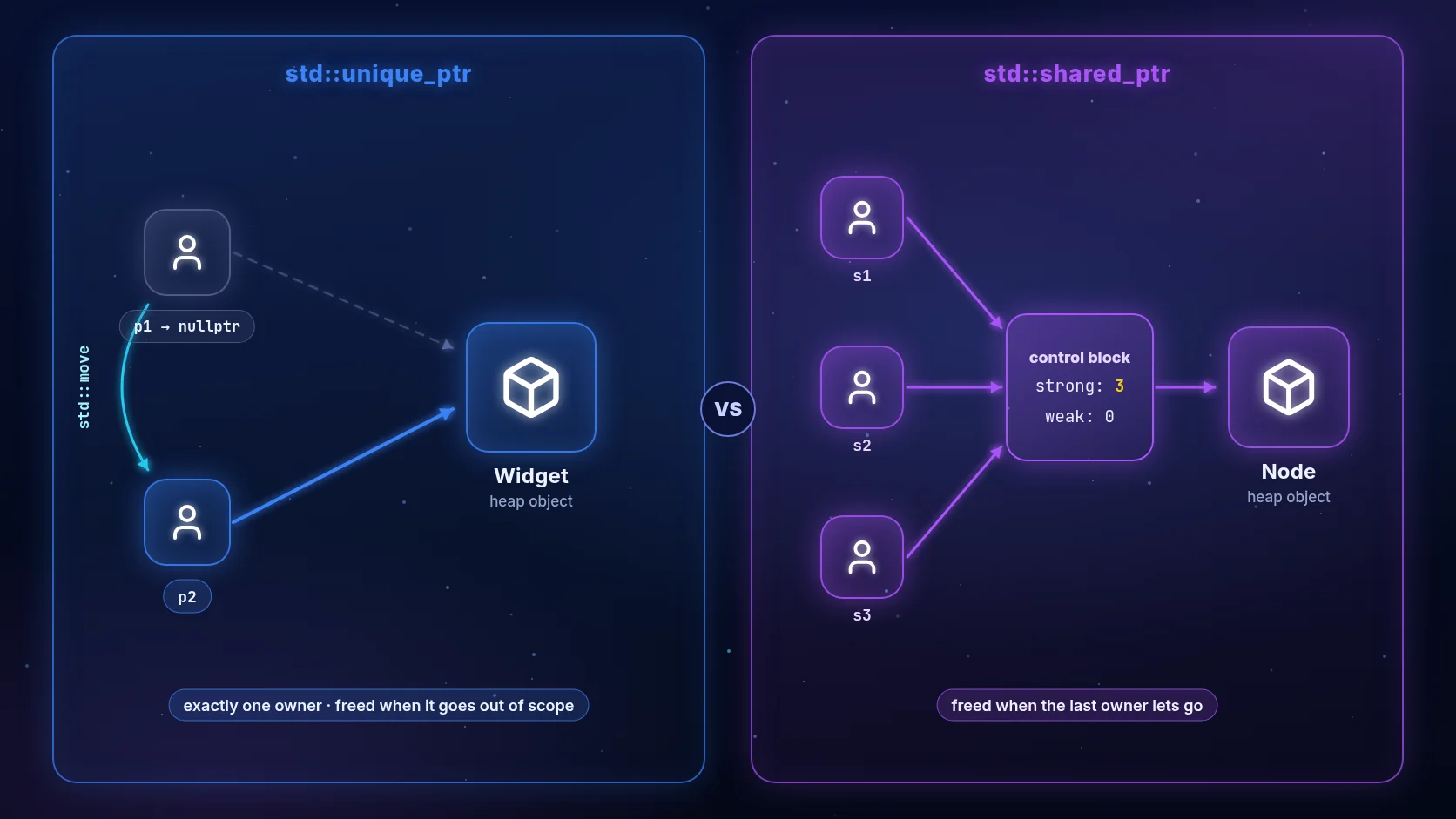
std::unique_ptr should be the first thing you reach for when you need to own a heap-allocated object. It has exactly one owner at a time, it’s move-only, and it compiles down to essentially the same machine code as a raw pointer with manual delete — there’s no reference-counting overhead, no atomic operations, nothing. If you’re not sharing ownership, there’s no reason to pay for shared_ptr.
#include <memory>

struct Connection {
    void query(const std::string& sql);
};

std::unique_ptr<Connection> open_connection() {
    auto conn = std::make_unique<Connection>();
    return conn; // moved out, not copied — unique_ptr has no copy constructor
}

void run() {
    auto conn = open_connection();
    conn->query("SELECT 1");
} // Connection destroyed automatically here, no leak even if query() throws
Always prefer std::make_unique<T>(args...) over std::unique_ptr<T>(new T(args...)). It’s not just shorter — it avoids a subtle exception-safety hole where, in certain expressions with multiple arguments, the new could succeed but a sibling expression could throw before the raw pointer is ever wrapped, leaking the allocation. make_unique closes that gap by construction.
Transferring ownership is explicit and visible at the call site:
std::unique_ptr<Connection> a = std::make_unique<Connection>();
std::unique_ptr<Connection> b = std::move(a); // a is now null, b owns it
No copy is silently made, no ambiguity about who’s responsible for the object after that line. That’s the whole value proposition — ownership transfer is a language-level, compiler-checked operation instead of a convention you hope everyone follows.
shared_ptr and weak_ptr: When Ownership Is Genuinely Shared
Reach for std::shared_ptr only when multiple independent owners genuinely need to keep an object alive, and none of them can be identified as “the” owner up front — a cache shared across threads, a graph node referenced from several parents, an object handed off to an async callback that might outlive the caller.
#include <memory>
#include <vector>

struct Texture {
    std::vector<uint8_t> data;
};

class Sprite {
    std::shared_ptr<Texture> texture_;
public:
    explicit Sprite(std::shared_ptr<Texture> tex) : texture_(std::move(tex)) {}
};

auto shared_tex = std::make_shared<Texture>();
Sprite s1(shared_tex);
Sprite s2(shared_tex); // both sprites keep the texture alive; freed when both are gone
shared_ptr isn’t free. Every copy bumps an atomic reference count (thread-safe, so there’s real synchronization cost under contention), and make_shared allocates the control block and the object in one block — which is more cache-friendly than two separate allocations, but it also means the memory for the object can’t be reclaimed until every weak_ptr referencing it is gone too, not just every shared_ptr.
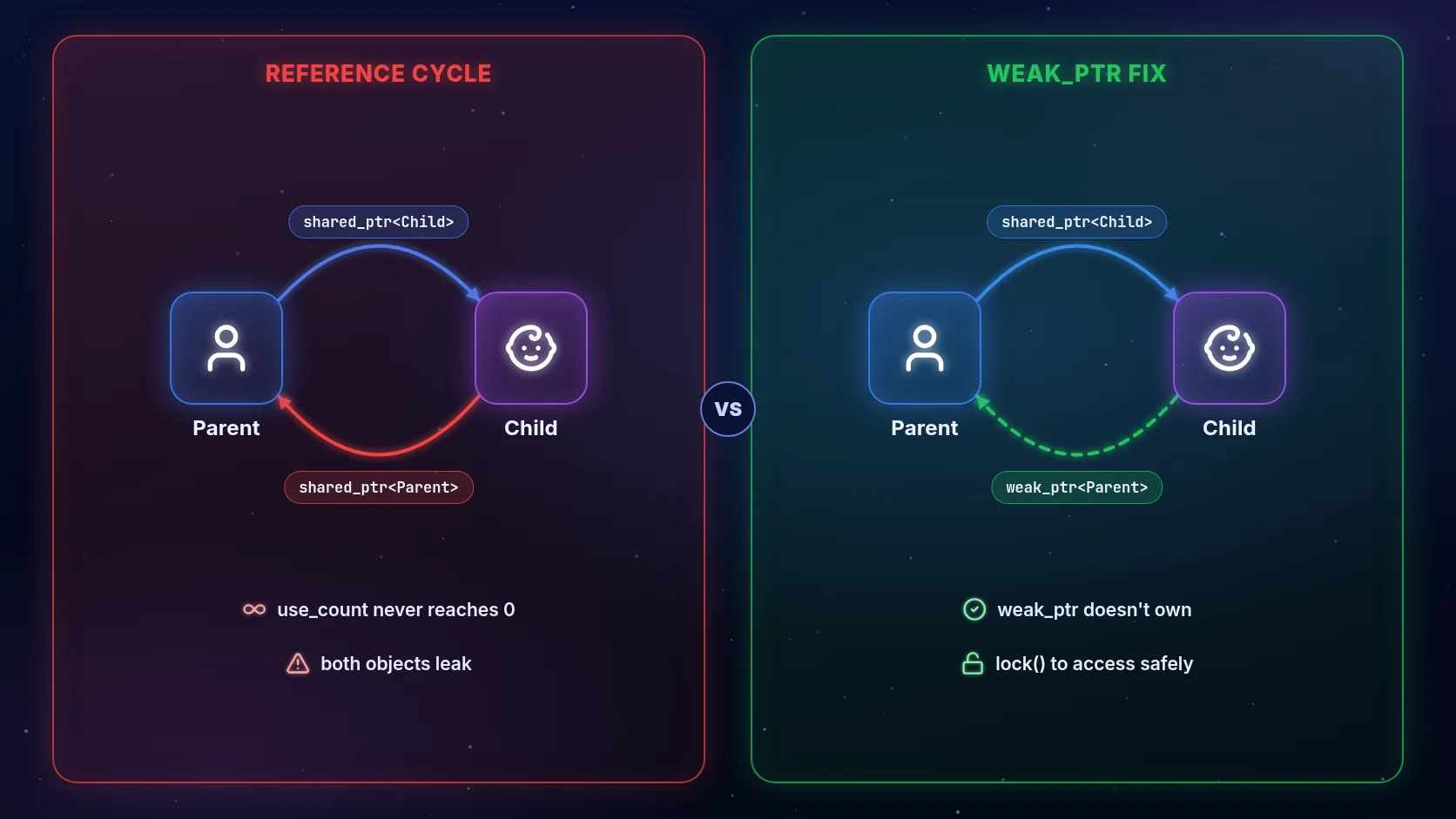
That leads directly into the classic shared_ptr trap: reference cycles. If A holds a shared_ptr to B and B holds a shared_ptr back to A, neither reference count ever hits zero, and both leak silently — no crash, no warning, just memory that never comes back.
struct Node {
    std::shared_ptr<Node> parent;   // wrong: creates a cycle if child also holds parent
    std::vector<std::shared_ptr<Node>> children;
};
The fix is std::weak_ptr for any “back-reference” that shouldn’t itself keep the object alive:
struct Node {
    std::weak_ptr<Node> parent;     // doesn't affect parent's reference count
    std::vector<std::shared_ptr<Node>> children;

    void greet_parent() {
        if (auto p = parent.lock()) { // returns a shared_ptr, or empty if parent is gone
            // safe to use p here
        }
    }
};
weak_ptr observes without owning. It can’t be dereferenced directly — you call .lock(), which atomically produces a shared_ptr if the object is still alive, or an empty one if it’s already been destroyed. That single method is what makes it safe to hold a non-owning reference to something that might disappear out from under you, which a raw pointer can never guarantee on its own.
unique_ptr vs shared_ptr: Picking the Right One
unique_ptr |
shared_ptr |
|
|---|---|---|
| Ownership | Single, exclusive | Shared, reference-counted |
| Copyable | No (move-only) | Yes (atomic refcount bump) |
| Overhead | Same as raw pointer | Control block + atomic ops |
| Typical use | Default choice, factory returns, PImpl | Caches, graphs, async handoff |
| Cycle risk | None | Yes — pair with weak_ptr |
A good rule of thumb I’ve settled into: start every new heap allocation as unique_ptr. Only promote it to shared_ptr when a second owner shows up that genuinely needs to extend the object’s lifetime — not just “needs a reference to it,” which is what a raw pointer or reference parameter is for. Most codebases I’ve reviewed have far more shared_ptr than they actually need, usually because it was easier to reach for than to think through who really owns what.
Move Semantics: How Smart Pointers Transfer Ownership for Free
Move semantics (from C++11 onward) are what make unique_ptr practical to pass around and return from functions without any performance penalty. A move transfers the internal pointer and nulls out the source — no allocation, no copy, no reference-count churn.
std::unique_ptr<Connection> make_pool_connection() {
    auto conn = std::make_unique<Connection>();
    // ... setup work ...
    return conn; // guaranteed move (or elided entirely by NRVO)
}
This is also why functions that only need to use an object, not own it, should take a raw pointer or reference — not a unique_ptr or shared_ptr by value. Passing a smart pointer by value when you don’t need ownership forces an unnecessary move or, worse, an unnecessary atomic refcount bump for shared_ptr.
// Bad: forces a shared_ptr copy just to read the object
void log_query(std::shared_ptr<Connection> conn);

// Good: no ownership implied, no refcount touched
void log_query(const Connection& conn);
A useful mental check before choosing a parameter type: does this function need to keep the object alive after it returns? If not, it doesn’t need a smart pointer at all.
When You Still Need Raw Pointers in Modern C++
Smart pointers handle ownership. Raw pointers and references are still the right tool the moment ownership isn’t the question:
- Non-owning observation. A function that reads or mutates an object it doesn’t own should take
T*orT&, not a smart pointer. This is the single most common place I still see people over-applyshared_ptrout of habit. - Performance-critical inner loops. In hot paths — physics steps, render loops, parsers processing megabytes of input — the atomic operations behind
shared_ptrcopies are measurable. Raw pointers or references into memory owned elsewhere avoid that cost entirely. - C API interop. Any function boundary talking to a C library, a driver, or hardware wants a raw pointer, because that’s the ABI. You still wrap the ownership in a smart pointer with a custom deleter on the C++ side — the raw pointer only exists at the boundary.
- Non-owning optional reference to something with a longer lifetime than the local scope, where the alternative (
weak_ptr+.lock()everywhere) adds overhead nothing in that code path actually needs.
Custom deleters are the bridge for C APIs — you get RAII safety around a resource that isn’t new/delete at all:
struct FileCloser { void operator()(std::FILE* fp) const { if (fp) std::fclose(fp); } };
std::unique_ptr<std::FILE, FileCloser> file(std::fopen("data.bin", "rb"));
// closed automatically, no manual fclose needed, still zero-overhead
The rule that’s served me well: raw pointers for access, smart pointers for ownership. If you keep that boundary clean, a raw pointer in your codebase is never a red flag — it’s a signal that this code deliberately isn’t the owner, which is exactly the information you want at a glance.
Common Memory Management Mistakes Even With Smart Pointers
Smart pointers remove entire bug classes, but they don’t make memory management mistake-proof:
- Calling
get()and storing the raw pointer past the smart pointer’s lifetime.unique_ptr::get()andshared_ptr::get()return the underlying raw pointer without any lifetime guarantee — if the owning smart pointer is destroyed, that raw pointer dangles. - Mixing
newandmake_unique/make_sharedinconsistently across a codebase. Pick one style; inconsistency is where the accidental rawnewwith no wrapper creeps back in. - Using
shared_ptras a default “I’m not sure who owns this” fallback. It works, but it hides a design question you should actually answer, and it leaves cycle bugs waiting to happen. - Forgetting
enable_shared_from_thiswhen an object needs to hand out ashared_ptrto itself (e.g., from inside a member function for an async callback) — constructing a newshared_ptrfromthisdirectly creates a second, unrelated control block and a guaranteed double-free. - Capturing
thisin a lambda that outlives the object, instead of capturing aweak_ptrand locking it inside the callback.
// Correct pattern for async self-references
class Worker : public std::enable_shared_from_this<Worker> {
public:
    void start_async() {
        auto self = weak_from_this();
        do_async_work([self]() {
            if (auto strong = self.lock()) strong->on_complete();
        });
    }
};
FAQ: Modern C++ Memory Management
Is new/delete ever acceptable in modern C++?
Rarely, and almost never directly in application code. Library and container implementations still use it under the hood, and you’ll see it inside a custom allocator or the internals of a smart pointer itself. Outside of that, if you’re typing new in 2026 application code, ask whether make_unique or make_shared should be there instead.
Does shared_ptr cause memory leaks?
Not by itself — but a reference cycle between two or more shared_ptrs will, since the reference count never reaches zero. Break the cycle with weak_ptr on whichever side is the “back” or “non-owning” reference (parent pointers, observer lists, cache entries).
Is unique_ptr slower than a raw pointer?
No. unique_ptr is designed to have zero overhead over a raw pointer in optimized builds — no extra memory, no extra indirection, no runtime cost, just compiler-enforced move-only semantics.
When should I use std::make_shared instead of std::shared_ptr<T>(new T)?
Almost always use make_shared. It allocates the object and the control block in a single heap allocation instead of two, which is faster and more cache-friendly, and it has the same exception-safety benefit as make_unique.
Can I convert a unique_ptr to a shared_ptr?
Yes, via move: std::shared_ptr<T> sp = std::move(up);. The reverse isn’t possible — a shared_ptr can’t be converted back to unique_ptr, since ownership may already be shared elsewhere.
Closing Thought
None of this is new language machinery — unique_ptr and shared_ptr have been standard since C++11. What’s changed by 2026 is that there’s no excuse left not to use them. Compilers optimize them down to nothing extra, static analyzers flag raw new/delete pairs automatically, and every major codebase I’ve touched this year treats manual memory management as something you do at a boundary, not as the default. Get comfortable with the ownership question — who owns this, for how long, and does anyone else need to — and the actual pointer type you reach for becomes the easy part.