Python 3.14: New Features Every Developer Should Know in 2026
Every October brings a new CPython release and every October I skim the changelog, shrug, and move on — most releases are incremental. Python 3.14 is not one of those years. Between free-threaded Python losing its “experimental” label, a genuinely new string type, and subinterpreters finally becoming usable from plain Python code, this is the first release in a while where I actually rewrote some of my own code after reading the changelog. Here’s what’s real, what’s marketing, and what you should actually go learn.
Why Python 3.14 matters more than the last few releases
For years the Python core team shipped safe, boring, backward-compatible releases — a few stdlib additions, some performance tuning, the occasional syntax sugar. That was the right call while the ecosystem caught up with 3.x, but it also meant most “what’s new in Python X.Y” posts were skippable.
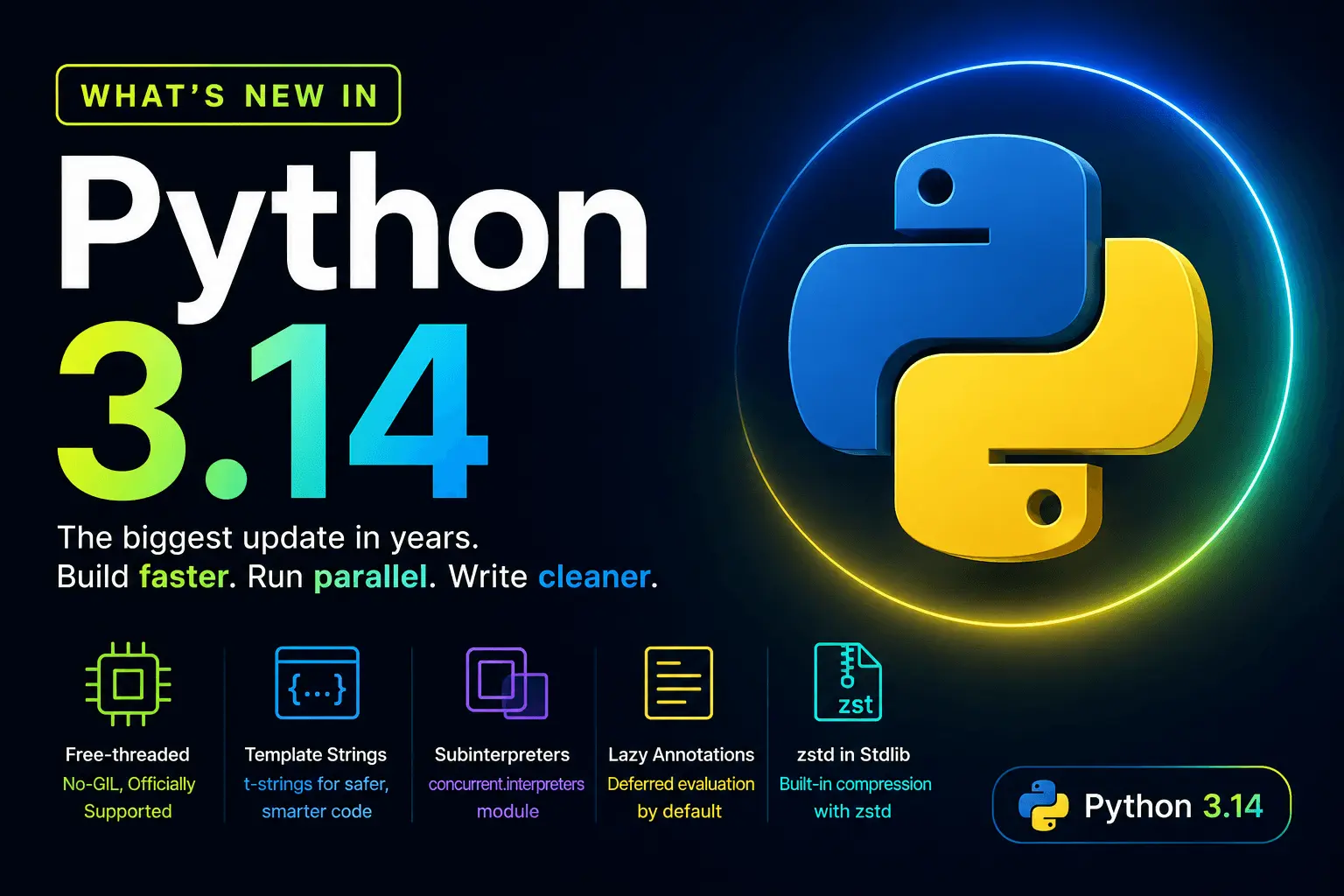
Python 3.14 breaks that pattern because it ships three separate multi-year efforts landing at once: the free-threaded build (removing the GIL) moving from experimental to officially supported, the multiple-interpreters C API finally getting exposed to pure Python code, and a new string literal type that changes how you should be writing anything that builds SQL, HTML, or shell commands from user input. None of these are cosmetic. Each one changes how you’d architect a new project today versus eighteen months ago.

Free-threaded Python (PEP 779): the GIL is now optionally gone, officially
The Global Interpreter Lock has shaped every Python performance conversation for three decades — one thread executes Python bytecode at a time, full stop, no matter how many cores your machine has. Python 3.13 shipped an experimental free-threaded build (python3.13t) that let you compile CPython without the GIL. Python 3.14 promotes that build from experimental to officially supported under PEP 779.
What actually changed:
# install the free-threaded build alongside the normal one
python3.14t -c "import sys; print(sys._is_gil_enabled())"
# False -> GIL is genuinely off, real parallel threads
import threading

def cpu_heavy(n):
    total = 0
    for i in range(n):
        total += i * i
    return total

threads = [threading.Thread(target=cpu_heavy, args=(10_000_000,)) for _ in range(4)]
for t in threads:
    t.start()
for t in threads:
    t.join()
# On python3.14t this actually uses 4 cores concurrently.
# On regular python3.14 it doesn't, same as it never has.
The catch, and it’s a real one: “officially supported” does not mean “default." You still opt in by installing the t build, and a meaningful chunk of the C-extension ecosystem (NumPy, some database drivers, older Cython-compiled packages) needs to explicitly declare thread-safety before it works correctly without the GIL as a safety net. Some already have; a lot haven’t. If you flip on free-threading in a project with a deep dependency tree today, test aggressively before you trust it in production — this is the year it became viable, not the year every library caught up.
Template strings (PEP 750): t-strings are the biggest new syntax in years
This is the one I think most developers will actually use daily. Python 3.14 adds a new string prefix, t"...", that looks exactly like an f-string but behaves completely differently: instead of immediately interpolating values into a plain str, it produces a Template object holding the literal text and the interpolated values separately, unevaluated as a final string.
name = "Anoop"
greeting = t"Hello, {name}!"
print(type(greeting))          # <class 'string.templatelib.Template'>
print(greeting.strings)        # ('Hello, ', '!')
print(greeting.interpolations) # (Interpolation(value='Anoop', expression='name', ...),)
Why does this matter more than it sounds like it does? Because it gives library authors — and you — a safe hook to intercept interpolated values before they become a raw string. That’s exactly the gap that caused a decade of SQL injection and unescaped-HTML bugs from careless f-string use.
def safe_sql(template):
    query = ""
    params = []
    for part in template:
        if isinstance(part, str):
            query += part
        else:
            query += "%s"
            params.append(part.value)
    return query, params

user_id = "1 OR 1=1"  # attacker-controlled input
q, p = safe_sql(t"SELECT * FROM users WHERE id = {user_id}")
print(q)  # SELECT * FROM users WHERE id = %s
print(p)  # ['1 OR 1=1']  -> stays a bound parameter, never gets concatenated into SQL
With an f-string, that same line would have silently concatenated attacker input straight into the query string. With a t-string, the interpolated value never touches the literal text unless your handling function explicitly lets it. Expect Django, SQLAlchemy, and templating libraries to start shipping t"..."-aware APIs over the next year or two — this is a foundational primitive, not a one-off feature.
PEP 734: multiple interpreters land in the standard library
CPython has had a C API for running multiple isolated interpreters in one process for years, but it was C-only — invisible from pure Python. Python 3.14 exposes it through a new concurrent.interpreters module, giving you a third concurrency model alongside threads and processes: separate interpreters, each with its own GIL (on non-free-threaded builds) and its own module state, running in the same OS process.
import concurrent.interpreters as interpreters

interp = interpreters.create()
interp.exec("print('running in an isolated interpreter')")

# pass data across the interpreter boundary via a queue
import concurrent.interpreters as interpreters
from concurrent.interpreters import create_queue

q = create_queue()
interp = interpreters.create()
interp.prepare_main(q=q)
interp.exec("q.put(sum(range(1_000_000)))")
print(q.get())
Why this over multiprocessing? Lower overhead — no separate OS process, no fork/spawn cost, no pickling everything across a pipe — while still giving you real memory isolation between interpreters, unlike threads. It sits in a genuinely useful middle ground: safer than shared-state threading, cheaper than full multiprocessing. Combine it with the free-threaded build and you get four distinct concurrency tools in 3.14 (threads, free-threaded threads, subinterpreters, and processes), each with a different isolation/overhead tradeoff — picking the right one is now an actual design decision instead of “just use multiprocessing because threads don’t scale.”

Deferred evaluation of annotations is now the default behavior
PEP 649 (mechanism) and PEP 749 (rollout) finish landing in 3.14: type annotations are no longer evaluated eagerly at function/class definition time. Instead they’re computed lazily, on demand, through a new annotationlib module.
def f(x: SomeClassDefinedLater) -> None: ...
class SomeClassDefinedLater: ...
# In 3.13 without `from __future__ import annotations`, this raised NameError.
# In 3.14, it just works — the annotation is only evaluated if something asks for it.

import annotationlib
print(annotationlib.get_annotations(f))
If you’ve ever added from __future__ import annotations to a file purely to dodge a forward-reference NameError, you can now drop it — that behavior is the default. Static type checkers (mypy, pyright) already assumed something close to this, so the practical day-to-day impact for most developers is: forward references just work, annotation-heavy code imports faster since nothing gets evaluated it doesn’t need, and one more class of “why does this only break at import time” bugs disappears.
Smaller changes that add up
A few more Python 3.14 changes that don’t need their own section but are worth knowing:
except/except*without parentheses (PEP 758):except ValueError, TypeError:now works for catching multiple exception types, matching the parenthesized form you already know — purely a readability win, zero behavior change.compression.zstd: Zstandard compression joinsgzip,bz2, andlzmain the standard library. Zstd is faster and compresses better than gzip at comparable settings — one less third-party dependency for anything touching large payloads or archives.- Colorized, clearer tracebacks by default: the interactive interpreter now highlights the exact expression that failed in a traceback, not just the line — genuinely faster to spot the bug at 2 AM.
- Remote attach for
pdb: you can now attach the debugger to an already-running process viapython -m pdb -p <pid>, without having pre-planted a breakpoint. Big deal for debugging a stuck production process without restarting it. uuidgains UUID versions 6, 7, and 8: UUID7 in particular is time-sortable, which makes it a much better default primary-key format than UUID4 for anything backed by a B-tree index.
Real-world use case: where these features actually change how you’d build something
Say you’re building a web scraper that hits a dozen sites concurrently, parses HTML, and writes normalized rows to Postgres. Under 3.13 you’d likely reach for asyncio plus aiohttp for the I/O-bound fetching, and if any CPU-bound parsing/cleanup got heavy, a ProcessPoolExecutor to dodge the GIL.
Under 3.14, the same project has real alternatives worth evaluating: concurrent.interpreters for the CPU-bound HTML parsing (cheaper than spinning up worker processes for a task that doesn’t need full OS isolation), t"..."-based query building instead of raw f-strings for the Postgres writes (closing off SQL injection risk without a heavier ORM), and compression.zstd if you’re archiving raw HTML for reprocessing later. None of these are mandatory rewrites — but each is a case where the “default” answer from a year ago has a genuinely better option now.
FAQ
Is the GIL actually gone in Python 3.14?
Only if you install the free-threaded build (python3.14t) explicitly. The standard python3.14 binary still has the GIL, same as every prior version. PEP 779 means the no-GIL build is now officially supported and no longer labeled experimental — it doesn’t mean the GIL is gone by default.
Should I switch to the free-threaded build right now? For a new project with few C-extension dependencies, it’s worth trying. For anything with a deep dependency tree — NumPy, database drivers, older compiled packages — test thoroughly first. Thread-safety declarations across the ecosystem are still catching up.
What’s the difference between t-strings and f-strings?
An f-string immediately produces a finished str with values interpolated in. A t-string produces a Template object that keeps the literal text and the interpolated values separate and unevaluated, so a function you pass it to can decide how to safely handle each value before anything becomes a final string.
Do I need concurrent.interpreters instead of multiprocessing?
Not a replacement — a third option. Subinterpreters cost less than full processes (no fork, no pickling across a pipe) while still isolating memory, unlike plain threads. Use it when process-level isolation is overkill but shared-state threading feels risky.
Will my old code break on Python 3.14? The headline features are additive and opt-in — t-strings need a new prefix, free-threading needs a different binary, subinterpreters need a new import. The deferred-annotations default is the one behavior change that’s on by default for everyone, and it’s very unlikely to break real code; it mainly fixes previously-broken forward references.
Closing thought
Most Python releases ask you to read the changelog once and move on. 3.14 is asking something different — it’s handing you three new tools (safe string templating, a real subinterpreter API, and an officially supported no-GIL runtime) that only pay off if you actually change how you write code. You don’t have to adopt all three today, but if you’re still building anything that touches user-supplied strings in SQL or HTML, t"..." is worth learning this week, not eventually.