5 Agentic AI Design Patterns Every Developer Should Know in 2026
Every “how to build an AI agent” tutorial teaches you one loop and stops there. Fine for a demo, useless the first time you’re staring at a real system that needs to decide between five different ways of wiring an LLM into a workflow. What I kept missing was the thing every other corner of software engineering already has: a catalog. Not “here’s how to build an agent” — here’s the menu of patterns, when each one earns its complexity, and what breaks when you pick the wrong one.
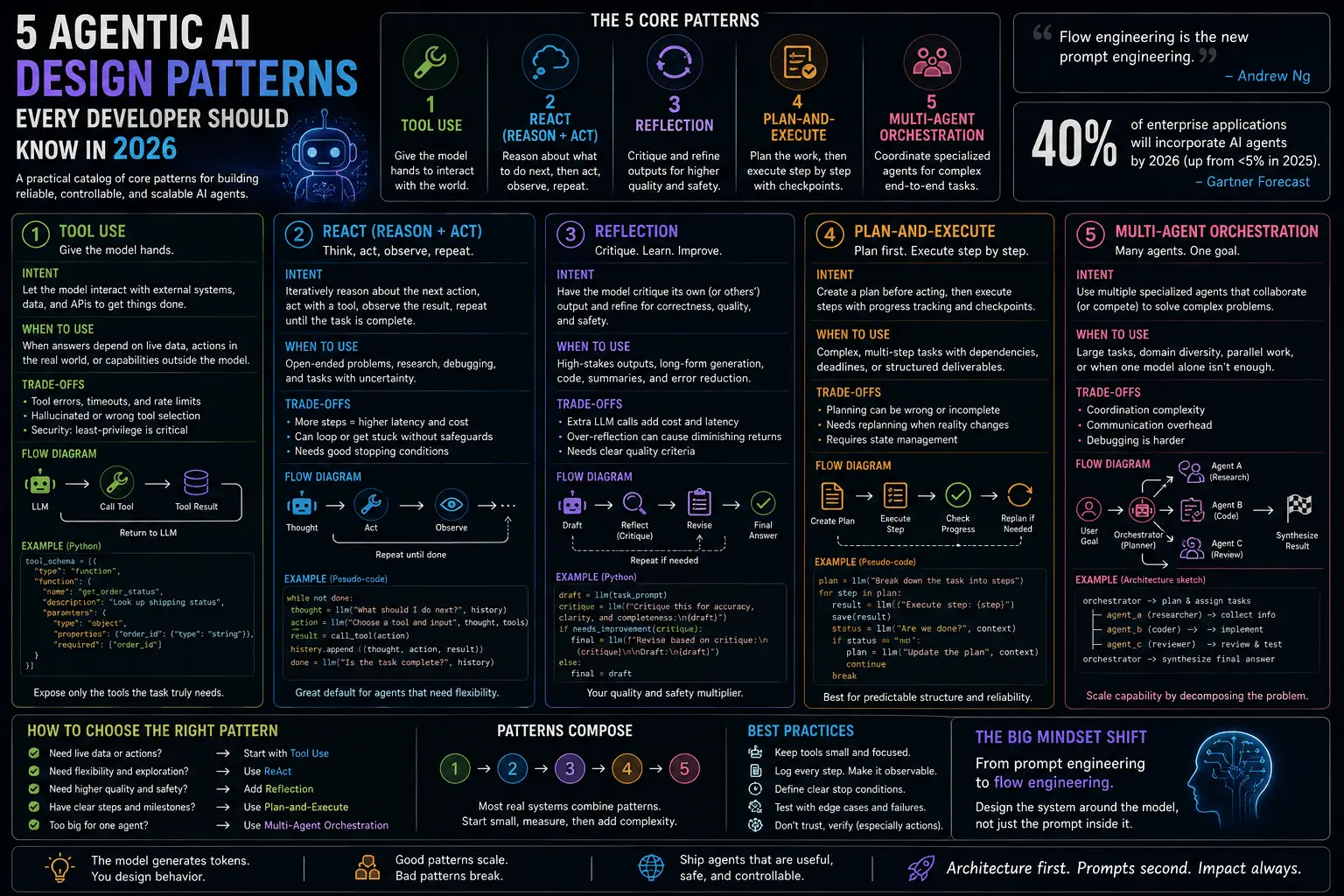
That’s what this post is. Think Gang-of-Four, but for agentic AI systems instead of object-oriented code. Five patterns, one write-up each: what it is, when to reach for it, what it costs you, and a short snippet showing the shape of it. Gartner’s forecast that 40% of enterprise applications will incorporate AI agents by 2026 — up from under 5% in 2025 — is the reason this catalog matters now instead of later. That’s a lot of teams about to make architecture decisions with no reference point.
Why agentic AI needs a pattern catalog, not just a tutorial
Andrew Ng popularized four foundational agentic patterns — reflection, tool use, planning, and multi-agent collaboration. Anthropic’s own engineering writeup on building effective agents lays out a similar but distinct set of five workflow patterns, built around composing simple, inspectable steps rather than reaching for a fully autonomous loop by default. Neither list is “the” canonical one, and that’s the actual point: these are architectural building blocks, not a single blessed algorithm. You pick and compose them based on the shape of your problem, the same way you’d pick Strategy over State depending on what varies at runtime.
The term that’s stuck for this in 2026 is flow engineering — designing the control flow, state transitions, and decision boundaries around LLM calls, and treating agent construction as a software architecture problem instead of a prompt-optimization problem. A prompt tunes what the model says in one call. A pattern decides how many calls happen, in what order, with what checkpoints, and who — model or code — gets to make each decision. That’s architecture, not prompting, and it deserves the same deliberate pattern language the rest of software engineering has had for decades.

Here’s the catalog, roughly ordered from “smallest architectural footprint” to “most moving parts”:
- Tool Use
- ReAct (Reason + Act)
- Reflection
- Plan-and-Execute
- Multi-Agent Orchestration
Pattern 1: Tool Use — give the model hands
Intent. Let the model interact with live data or real systems instead of answering only from what it memorized during training. This is the foundational pattern — nearly every other pattern in this list is a specific way of arranging tool calls, not a replacement for them.
When to use it. Any time the answer depends on information that changes after training cutoff, or any time the task requires doing something in the world — querying a database, hitting an internal API, sending an email, running a calculation you don’t trust the model to do in its head. If your system never needs current data and never needs to take an action outside generating text, you don’t need this pattern — you need a plain LLM call.
Trade-offs. Every tool you expose is also a new failure surface: malformed arguments, wrong tool picked, a tool call the model shouldn’t have been allowed to make unsupervised (deleting a row, sending a real email). Tool use is the pattern where “least privilege” from classic security design maps directly onto agent design — scope each tool as narrowly as the task allows.
tool_schema = [{
    "type": "function",
    "function": {
        "name": "get_order_status",
        "description": "Look up the current shipping status for an order ID",
        "parameters": {
            "type": "object",
            "properties": {"order_id": {"type": "string"}},
            "required": ["order_id"],
        },
    },
}]
# Model requests a call → your code executes it → result goes back in context.
# The model never touches the database directly; it only ever sees text.
That last line matters more than it looks: the model doesn’t call get_order_status — it describes the call it wants, and your code decides whether to actually run it. That boundary is where every access-control decision in an agentic system lives.
Pattern 2: ReAct — reason, act, observe, repeat
Intent. Interleave reasoning with action instead of separating “think” from “do.” Each cycle the model reasons about what it needs, acts by calling a tool, observes the result, and reasons again — adapting one step at a time instead of committing to a fixed plan up front.
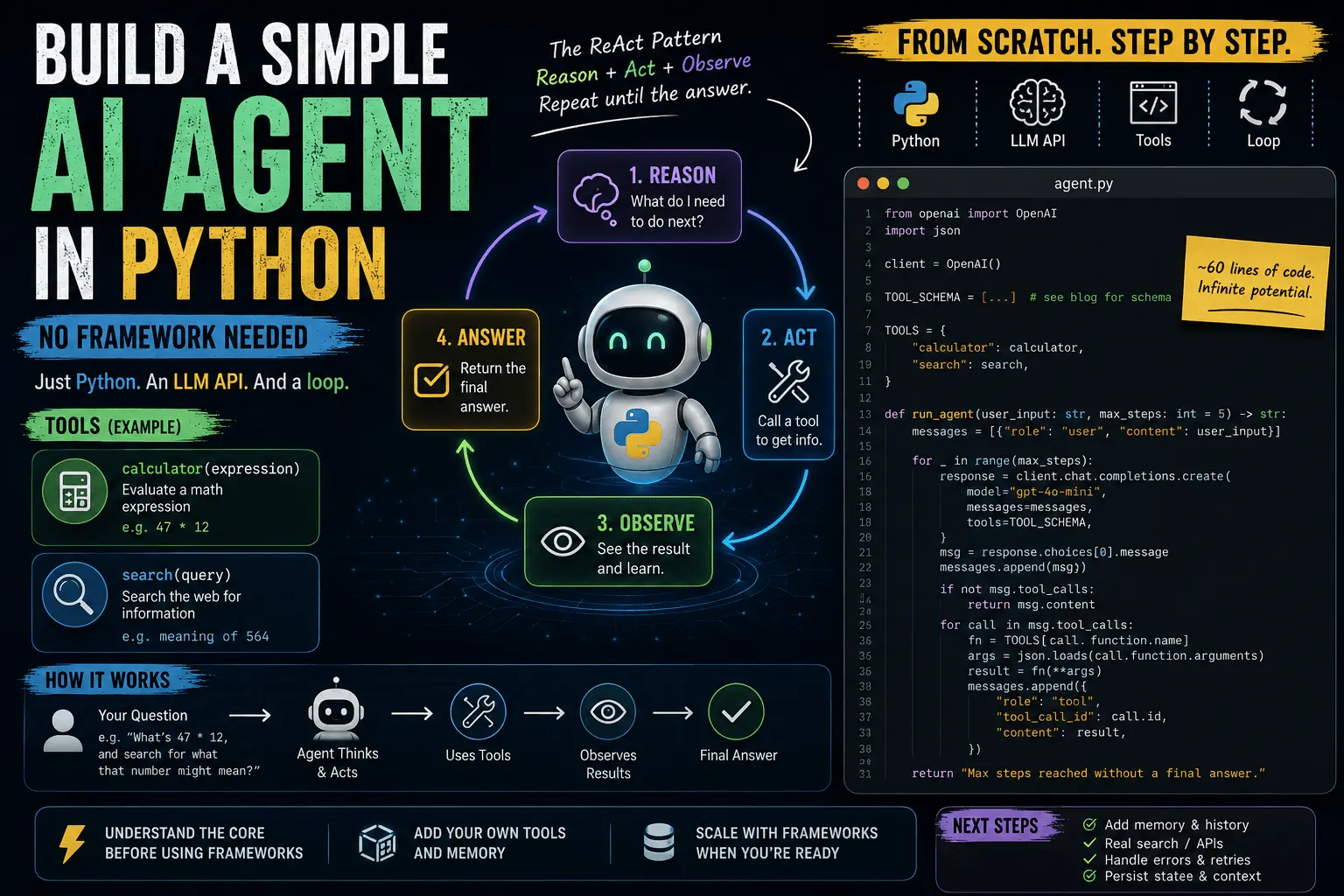
I’ve covered building a ReAct agent from scratch line by line in an earlier post, so I won’t re-run that build here — the short version for this catalog is what matters: ReAct is what you get when you take the Tool Use pattern and put it inside a loop with no separate planning phase. The model decides both what to do next and when to stop, one step at a time, based on what it just observed.
When to use it. Tasks where you can’t know the full sequence of steps in advance — the right next action genuinely depends on what the previous tool call returned. Research questions, multi-hop lookups, debugging tasks, anything where “search, then decide what to search for next based on the result” describes the work better than a fixed checklist.
Trade-offs. No separate plan means no separate plan review — you’re trusting the model’s step-by-step judgment call by call, which is fine for short-horizon tasks and gets expensive and hard to steer on long ones. Every iteration resends the growing conversation history, so cost and latency climb with step count, and a model that gets uncertain can loop on the same tool without ever converging unless you enforce a hard step ceiling.
for step in range(max_steps):          # hard ceiling — non-negotiable
    response = model.generate(messages, tools=tool_schema)
    if not response.tool_calls:
        return response.content        # reasoning resolved to a final answer
    for call in response.tool_calls:
        result = run_tool(call)        # act
        messages.append(tool_result(call, result))  # observe
Pattern 3: Reflection — let the agent critique its own output
Intent. Before the result ever reaches the user, have the agent (or a second pass of the same model) look at its own draft and check it against the original goal — then revise if it falls short. This is the pattern that turns “first plausible answer” into “answer that survived a second look.”
When to use it. Anywhere output quality matters more than latency, and errors are the kind a careful second pass would actually catch — logic errors in generated code, factual gaps in a summary, a plan that skipped a stated constraint. Reflection buys you a meaningfully more reliable output for roughly double the LLM calls on the reflected step.
Trade-offs. It’s not free, and it’s not magic. A reflection pass only catches what the critique step is actually checking for — if your critique prompt is as vague as “is this good?”, you’ll get a rubber stamp, not a real review. The critique step needs its own explicit criteria, the same way a human code reviewer needs a checklist instead of a vibe.
draft = model.generate(task_prompt)
critique = model.generate(f"""
Review this output against the original task: {task_prompt}
Output: {draft}
List concrete problems, or say "no issues found".
""")
if "no issues found" not in critique.lower():
    draft = model.generate(f"Revise given this critique: {critique}\nOriginal: {draft}")
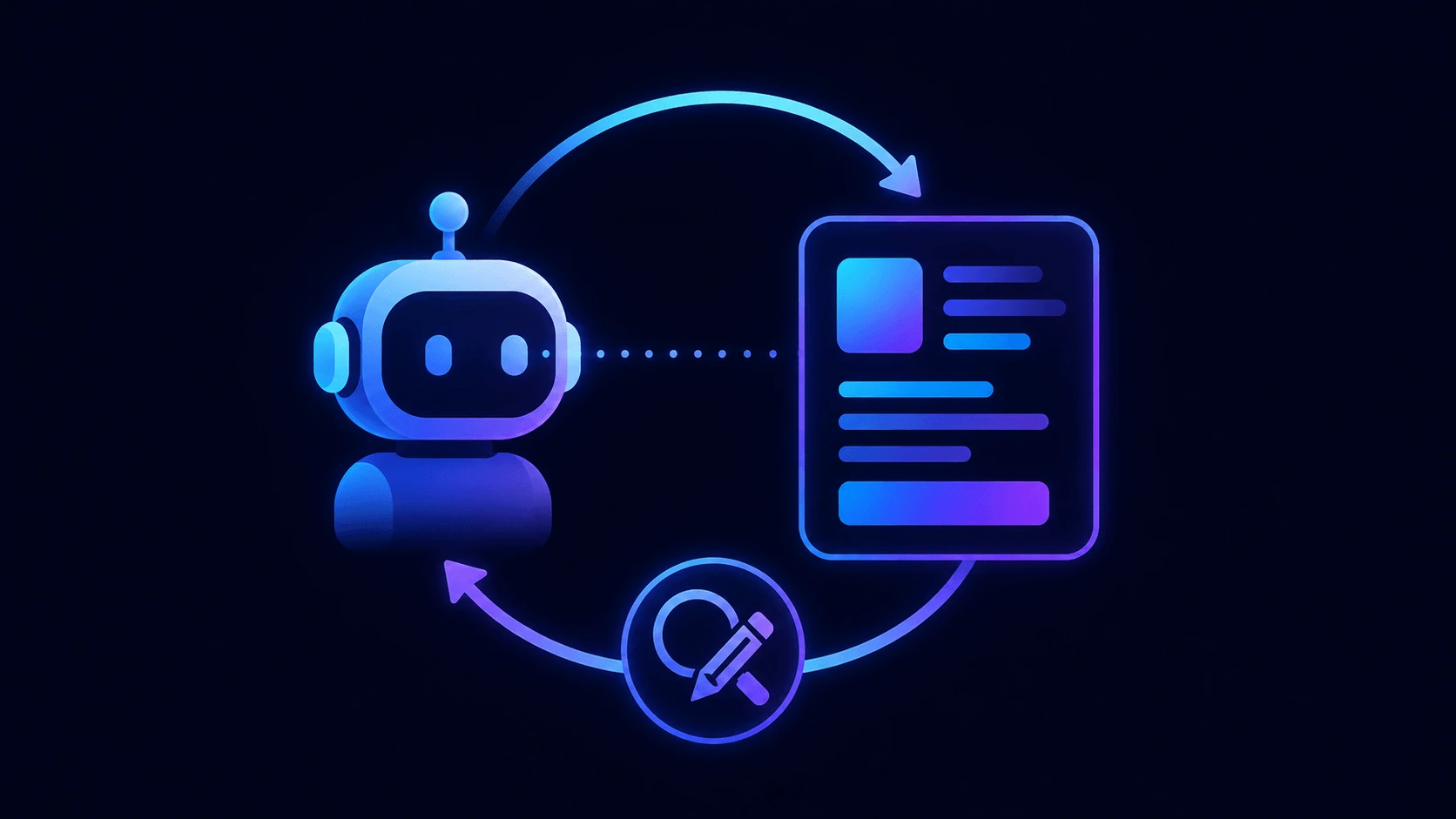
Reflection composes cleanly with almost every other pattern here — it’s less a standalone architecture and more a checkpoint you insert wherever the cost of a wrong answer justifies a second pass.
Pattern 4: Plan-and-Execute — separate strategy from tactics
Intent. Split the work into two distinct phases: a planning phase that produces a high-level sequence of steps toward a long-horizon goal, and an execution phase that carries each step out — with the plan itself reviewable, and revisable, before or during execution.
I wrote a full post on the Plan-Execute-Verify workflow for human-AI coding collaboration already, focused on the human discipline side of that loop — writing tight specs, reviewing plans like design docs, catching problems before code gets written. This entry is the architectural version of the same idea, viewed as one pattern among several rather than the whole philosophy: Plan-and-Execute is what you reach for when a task’s step count is too large, or too consequential, to let the model improvise its way through step by step the way ReAct does.
When to use it. Long-horizon goals with many steps, where committing to a wrong direction five steps in is expensive to unwind, and where a human — or a separate verification pass — genuinely benefits from seeing the whole intended path before any of it runs. Multi-file code changes, research reports with several sub-questions, anything where “here’s my plan, does this look right before I start” is a real, valuable checkpoint.
Trade-offs. The upfront plan can go stale — reality discovered mid-execution doesn’t always match what the planner assumed, so a rigid architecture that never lets execution feed back into replanning will happily keep executing a plan that’s already wrong. The fix is a replanning hook, not abandoning the pattern: check progress against the plan periodically and regenerate the remaining steps if execution reveals something the plan didn’t account for.
plan = planner_model.generate(f"Break this goal into ordered steps: {goal}")
# plan reviewed by a human or a checker before execution starts
for step in plan.steps:
    result = executor_agent.run(step)          # can itself be a ReAct loop
    if result.contradicts(plan):
        plan = planner_model.generate(f"Replan remaining steps given: {result}")
Note the executor for each step is often a ReAct loop internally — Plan-and-Execute isn’t a competitor to ReAct so much as a layer above it: ReAct handles the tactics of one step, Plan-and-Execute handles the strategy across all of them.
Pattern 5: Multi-Agent Orchestration — specialize and coordinate
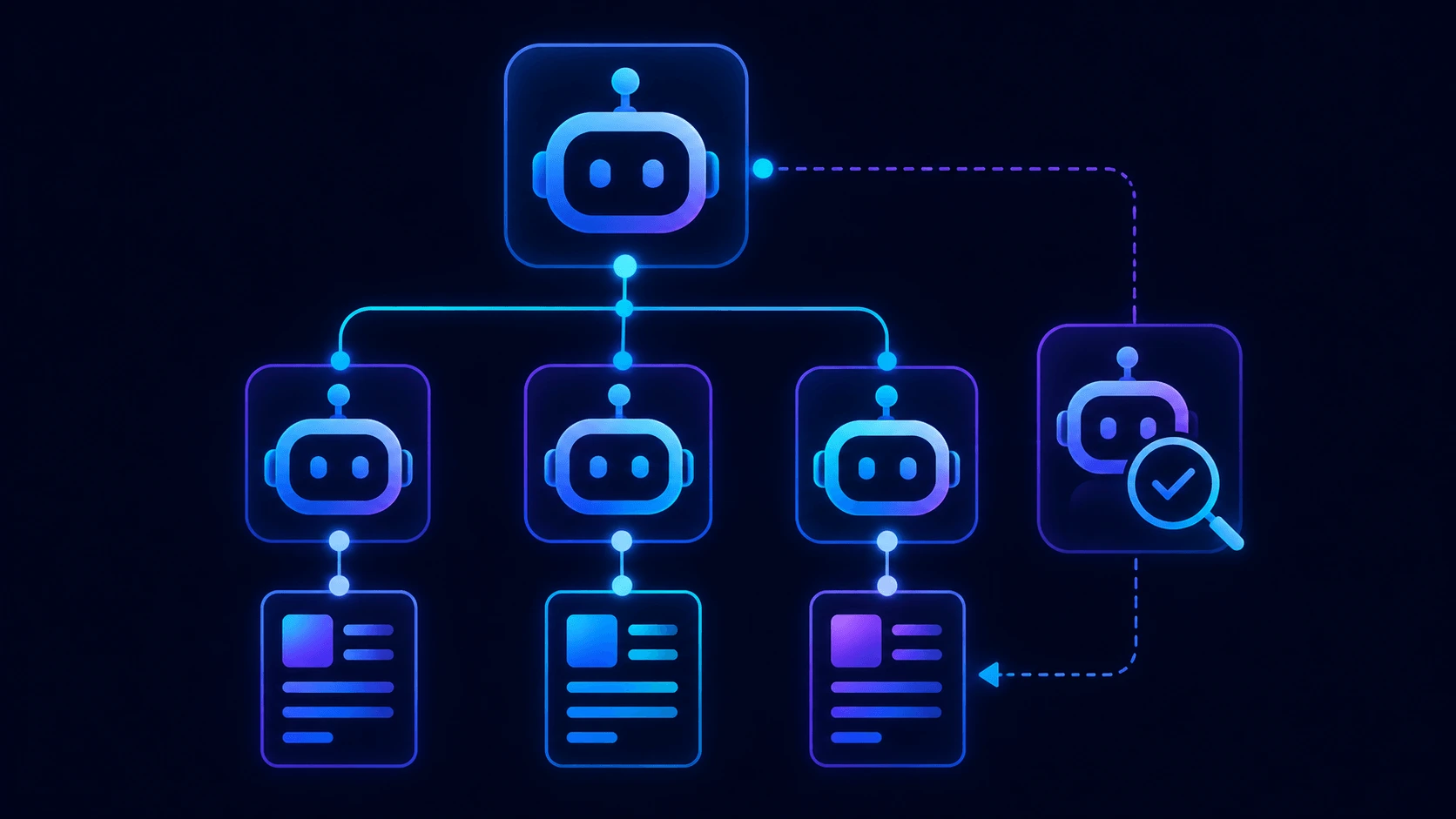
Intent. Split a task across multiple agents, each with a narrower role — a researcher, a writer, a reviewer, a coder — instead of asking one agent to hold every responsibility at once. Coordination between them can be a fixed pipeline, a manager agent dispatching to workers, or peer agents handing off to each other.
When to use it. Tasks that decompose cleanly into genuinely independent sub-problems, or tasks where a distinct “critic” role catches a category of error a single agent reliably misses when it’s grading its own homework. A dedicated reviewer agent checking a coder agent’s diff for security issues before a human ever looks at it is a common, well-earned version of this pattern.
Trade-offs. This is the most expensive pattern here, on every axis — token cost, latency, and genuine coordination complexity. Two agents handed overlapping, interdependent work produce a merge nightmare, agent or not; the pattern only pays for itself when the sub-tasks are actually independent, or when the extra specialization measurably improves output quality over a single well-designed agent. Don’t reach for multi-agent orchestration because it sounds more sophisticated — reach for it because a single agent’s context or role is demonstrably becoming the bottleneck.
plan = manager_agent.plan(goal)              # decompose
results = [worker_agent.run(subtask) for subtask in plan.subtasks]  # independent, parallel
reviewed = reviewer_agent.check(results)     # dedicated critic role
final = manager_agent.synthesize(reviewed)
Choosing the right agent architecture: a decision guide
Laid side by side, the question isn’t “which pattern is best” — it’s “which pattern matches this task’s shape.”
| Pattern | Best for | Main cost | Composes with |
|---|---|---|---|
| Tool Use | Any live-data or action need | New failure surface per tool | Foundation for all others |
| ReAct | Unpredictable, step-by-step tasks | No plan checkpoint, can loop | Executor inside Plan-and-Execute |
| Reflection | Quality-critical single outputs | ~2x calls on reflected step | Checkpoint inside any pattern |
| Plan-and-Execute | Long-horizon, high-stakes tasks | Plan can go stale mid-run | Wraps ReAct per step |
| Multi-Agent Orchestration | Independent sub-tasks, dedicated critic roles | Highest cost + coordination overhead | Wraps all of the above per agent |
A useful rule of thumb: start with Tool Use plus a plain single-agent loop. Add ReAct when the steps aren’t fully knowable up front. Add Reflection when a wrong output is expensive enough to justify a second pass. Reach for Plan-and-Execute when the task is long-horizon enough that a human wants to see the route before the agent drives it. Only bring in Multi-Agent Orchestration once you’ve actually hit the limits of a single well-scoped agent — not before.
How these agentic AI architecture patterns compose in practice
None of these live in isolation in a real system, and that’s the part a single-pattern tutorial never shows you. A realistic production agent for, say, an internal support bot might look like: Plan-and-Execute at the top level breaking a multi-part user request into steps, each step run by a ReAct loop that uses Tool Use to query internal systems, with a Reflection pass on the final response before it reaches the user, and — if the org is big enough to justify it — a separate reviewer agent checking for policy violations before anything ships. That’s four of the five patterns in one system, each solving a distinct, narrow problem, none of them doing the others' job.
That’s the actual craft of flow engineering: not picking the single cleverest pattern, but drawing the smallest set of boundaries that makes each piece of the system easy to reason about on its own.
FAQ
What’s the difference between ReAct and Plan-and-Execute? ReAct interleaves reasoning and action one step at a time with no separate planning phase — the model decides the next move based on what it just observed. Plan-and-Execute front-loads a full sequence of steps before execution starts, so the whole route is reviewable up front. ReAct suits unpredictable tasks; Plan-and-Execute suits long-horizon tasks where seeing the plan before it runs is worth the upfront cost.
Do I need multi-agent orchestration, or is a single agent enough? A single well-scoped agent using ReAct and Tool Use covers most tasks. Reach for multi-agent orchestration only when a task decomposes into genuinely independent sub-problems, or when a dedicated critic role catches errors a single self-grading agent reliably misses — not because it sounds more advanced.
Is Reflection worth the extra LLM calls? Depends entirely on the cost of a wrong answer. For quality-critical single outputs — generated code, factual summaries, anything with a real cost to being wrong — yes, a critique-and-revise pass with explicit criteria catches errors a first pass misses. For low-stakes, high-volume outputs, the extra calls usually aren’t worth it.
Can these patterns be combined in one system? Yes, and in real production systems they usually are. Tool Use is the foundation nearly everything else sits on top of; ReAct and Plan-and-Execute both operate at the level of “how does the agent move through steps”; Reflection is a checkpoint you can insert into either; Multi-Agent Orchestration is a layer above all of them for splitting work across specialized roles.
What is flow engineering? The practice of deliberately designing the control flow, state transitions, and decision boundaries around LLM calls — deciding how many calls happen, in what order, with what checkpoints, and whether the model or your code makes each decision. It treats agent construction as a software architecture discipline rather than pure prompt tuning.
Closing thought
I used to think getting better at agentic AI meant writing better prompts. It doesn’t — it means getting better at drawing boundaries: where the model reasons versus where your code decides, where a plan gets reviewed before it runs, where a second pass catches what the first one missed. Five patterns, one problem each. Pick the smallest set that actually matches the shape of what you’re building, and resist the urge to reach for the impressive-sounding one when the boring one would do the job.