

Microservices vs Modular Monolith in 2026: Which Architecture Actually Wins
Microservices vs modular monolith in 2026 — a practical breakdown of team size, deployment complexity, and the distributed systems tax, with real guidance on when each architecture wins.
On this page
I’ve shipped both. A 40-service microservices platform that took three teams a full quarter just to get a single feature through staging, and a modular monolith that a five-person team deploys twelve times a day without anyone sweating. The difference wasn’t the code quality of either team. It was that one architecture matched the org that built it, and the other was chosen because a conference talk made it sound inevitable.
That’s the conversation I keep having in 2026, still. Microservices vs modular monolith isn’t a solved debate — it’s a debate that got quieter because enough companies got burned publicly (Amazon’s Prime Video team famously reversed a microservices decision and cut costs 90% by going back to a monolith) that “it depends” finally started sounding like wisdom instead of a cop-out. This post is the “it depends,” made specific.
Why this debate refuses to die in 2026
Every few years the industry swings the pendulum. Early 2010s: monoliths are legacy, break everything into services. Late 2010s: service sprawl becomes its own crisis, “distributed monolith” enters the vocabulary as an insult. Early 2020s: modular monolith gets rebranded and rehabilitated. 2026: the tooling on both sides has matured enough — Kubernetes is boring now, but so are frameworks like Modulith for Spring and Wolverine for .NET that make monolith boundaries enforceable — that the choice actually comes down to organizational reality rather than technical limitation.
The mistake most teams still make is treating this as an architecture decision when it’s really an organizational one. Conway’s Law isn’t a fun observation, it’s a prediction: your system’s structure will mirror your communication structure whether you plan it or not. A microservices architecture layered onto a team that sits in one Slack channel and ships as a unit is fighting itself from day one.
What a modular monolith actually is (not “big ball of mud”)
A modular monolith gets a bad reputation because people assume it means no structure — one giant codebase where everything imports everything. That’s a monolith with no modularity, and it’s a real failure mode, but it’s not what “modular monolith” means.
A properly built modular monolith has:
- Enforced module boundaries — internal packages that can’t be imported across module lines except through defined interfaces, checked at build time or CI, not just by convention
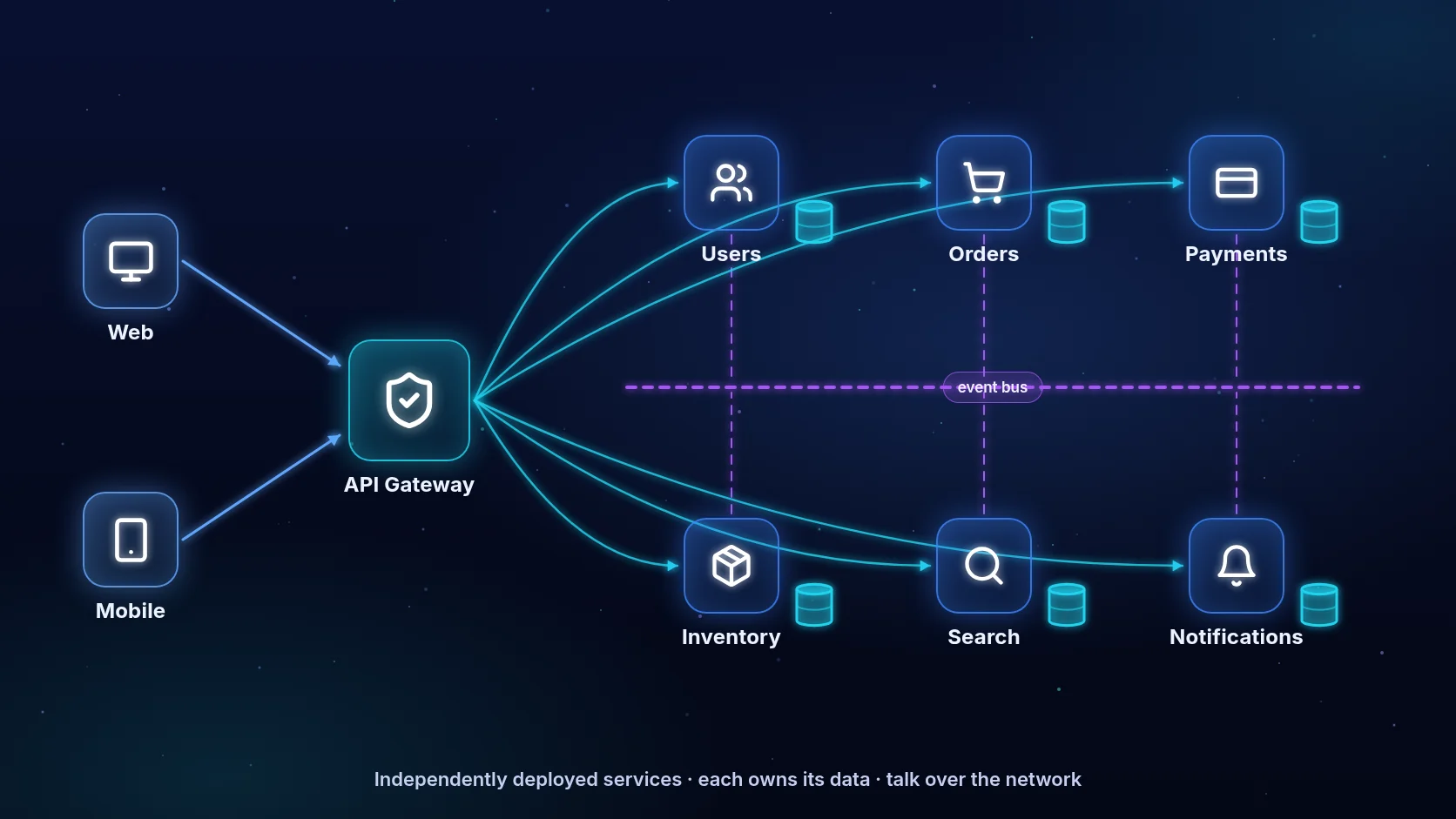
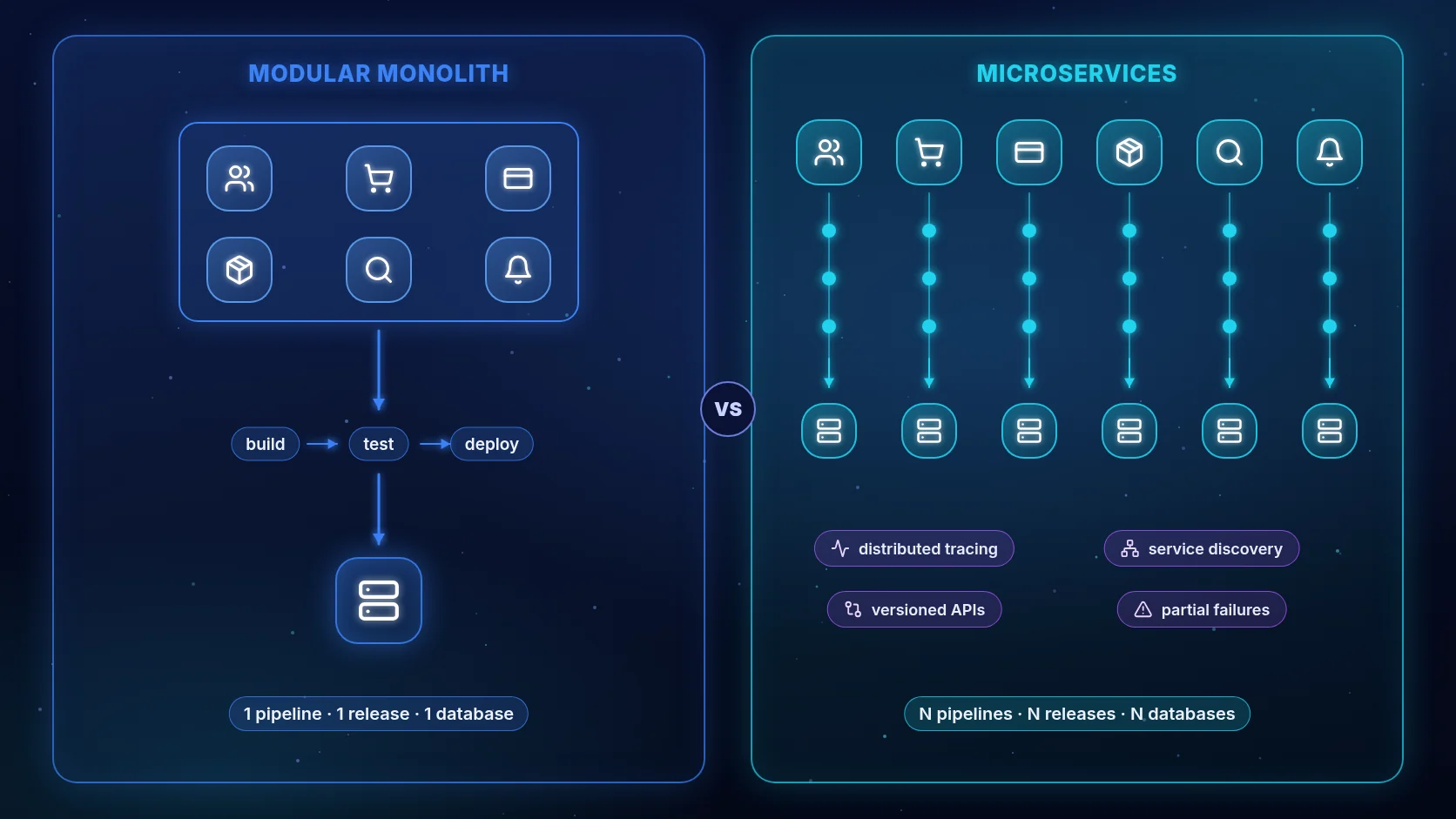
- A single deployable unit — one process, one deploy pipeline, one set of infrastructure to run
- Independent internal domains — billing, users, inventory, notifications each own their data model and logic, even though they share a process and often a database
- A clear extraction path — because the module boundaries are already clean, pulling one module out into its own service later is a mechanical exercise, not an archaeology project
The key insight: modularity and deployment topology are separate axes. You can have a beautifully modular system that deploys as one unit, and you can have a tangled mess that deploys as forty units. Microservices don’t buy you good boundaries — they just make bad boundaries expensive to fix, because now the leaky abstraction is a network call instead of a bad import.
The distributed systems tax nobody puts in the estimate
This is the part that gets glossed over in architecture diagrams, because diagrams show boxes and arrows, not the 3am pages. Every service boundary you draw is a promise to pay a recurring tax:
Network calls replace function calls. A function call fails in one way: it throws. A network call fails in a dozen ways — timeout, partial response, the service is up but slow, the service is up but returning stale data from a cache, DNS resolution hiccups, TLS handshake failures. Every one of those needs a retry policy, a circuit breaker, and a fallback decision, multiplied by every service-to-service edge in your graph.
Distributed transactions stop existing. In a monolith, a single database transaction wraps “debit this account, credit that one, write the audit log.” Split those across three services and you’re now building a saga pattern, compensating transactions, and idempotency keys — solving a problem your monolith gave you for free.
Observability becomes its own project. A stack trace in a monolith tells you what happened. A distributed trace across twelve services tells you what happened if every service propagated the trace context correctly, if your sampling rate caught the slow request, and if you can correlate logs across services with different retention policies. Teams routinely spend more engineering time building observability for microservices than they spent building the monolith they replaced.
Local development gets harder. Running one monolith on a laptop takes a few minutes. Running fifteen services with their own databases, message queues, and service discovery either means an elaborate docker-compose setup that someone maintains as a part-time job, or developers working against a shared staging environment and stepping on each other constantly.
Deployment coordination reappears in a new form. The pitch for microservices is independent deployability. The reality for many teams is that service A’s new API contract breaks service B, so you’re back to coordinated releases — except now it’s harder to coordinate because the services live in different repos, different pipelines, sometimes different teams' backlogs.
None of this means microservices are wrong. It means the tax is real, it’s continuous, and it needs to be paid by someone with the skills and staffing to pay it — every day, not just at launch.
Team size: the signal that matters more than traffic
Engineers love to frame this as a scale problem — “we’ll need microservices once we hit X requests per second.” That’s usually the wrong axis. Plenty of monoliths serve enormous traffic (Shopify, Basecamp, and Stack Overflow all ran — or still run — a majority of their traffic through a monolith at scales most companies will never reach). The axis that actually predicts whether microservices help or hurt is team size and team autonomy needs.
Under ~2 teams / 15 engineers: A modular monolith almost always wins. You don’t have enough people to staff separate on-call rotations, separate CI/CD pipelines, and separate infrastructure ownership per service. Splitting services here multiplies coordination overhead without buying autonomy, because the same three people are touching all of it anyway.
2-8 teams, clear domain ownership: This is the zone where it gets genuinely debatable. If teams are frequently blocked on each other’s release cycles, or if one team’s changes routinely cause outages in a domain they don’t own, service boundaries start paying for themselves. If teams mostly work in their own areas of a well-modularized codebase without conflict, the monolith is probably still fine — extract only the piece causing actual pain (usually the module with a different scaling profile, like an image-processing or notification pipeline).
8+ teams, high release-cadence independence needs: Microservices start winning decisively. At this scale the coordination cost of not having independent deployability exceeds the distributed systems tax. This is Amazon, Netflix, Uber territory — and worth noting, those companies also built entire internal platform teams whose sole job is making the distributed systems tax invisible to product teams. If you’re adopting the architecture without the platform investment, you’re taking the cost without the benefit.
A decision framework you can actually use
Skip the “how many requests per second” question. Ask these instead:
- How many teams need to deploy independently, right now, not hypothetically? If the honest answer is one or two, that’s your ceiling for service count regardless of domain count.
- Do you have dedicated platform/infra capacity to own the distributed systems tax? Service mesh, distributed tracing, on-call for cross-service incidents — if nobody owns this, microservices will erode reliability, not improve it.
- Where are your actual scaling bottlenecks? If one component (video encoding, PDF generation, ML inference) has wildly different resource needs than the rest, extracting that one thing gets most of the benefit without full decomposition.
- Can you draw clean module boundaries today, in the monolith? If your domains are still tangled enough that you can’t confidently say what “the billing module” even encompasses, splitting into services won’t fix that — it’ll just make the tangle harder to see and impossible to refactor.
- What’s your actual deployment frequency need? Teams that deploy weekly rarely need independent service deployability. Teams that need to ship five times a day per team, with zero cross-team blocking, have a real case.
If most of those point toward “small team, unclear boundaries, no dedicated platform capacity, uniform scaling needs” — build the modular monolith. Enforce the module boundaries with actual tooling (architecture tests, dependency-cruiser, ArchUnit, compiler-level module systems) so the boundaries aren’t just tribal knowledge. That gives you the extraction path for later without paying the tax now.
When microservices genuinely win
To be fair to the other side, because this isn’t a monolith-evangelism post: microservices are the right call when you have independent scaling needs that differ by orders of magnitude between components, when regulatory or security isolation genuinely requires separate deployment boundaries (PCI scope reduction is a legitimate driver), when multiple teams need to ship on entirely different cadences without blocking each other, and when you already have the platform engineering investment to make service ownership sustainable rather than aspirational.
The failure mode isn’t choosing microservices. It’s choosing microservices before any of those conditions exist, because the industry made it feel like the default rather than a specialization.
FAQ
Is modular monolith just a monolith with extra steps? No. The difference is enforcement. A modular monolith has module boundaries checked in CI — cross-module imports fail the build unless they go through a defined interface. A plain monolith has no such enforcement, so boundaries erode over months until everything depends on everything.
Can you migrate from modular monolith to microservices later? Yes, and it’s dramatically easier than migrating from an unstructured monolith. If your module boundaries are already clean and your modules already own their data, extracting one into a service is mostly a networking and deployment exercise, not a rewrite. This is the core argument for “monolith first.”
Do microservices always mean better scalability? No. A well-indexed monolith with a properly scaled database (read replicas, connection pooling, caching) handles far more traffic than most teams assume. Microservices help when different parts of your system need to scale independently, not as a general scalability strategy.
What’s the biggest hidden cost of microservices? Observability and debugging. A bug that spans three services requires distributed tracing, correlated logs, and often reproducing timing-dependent failures across process boundaries — work that doesn’t exist in a monolith where a debugger and a stack trace get you most of the way there.
Should a startup ever start with microservices? Almost never. Startups are optimizing for finding product-market fit fast, which means changing domain boundaries constantly — and domain boundaries are exactly what microservices make expensive to change. Start modular monolith, extract only when a specific, measured pain justifies it.
Closing thought
Neither architecture is a maturity badge. Microservices aren’t what “serious” engineering orgs graduate to, and monoliths aren’t what you settle for until you’re big enough. They’re two different answers to the same question — how do we let independent teams ship independently without the system falling apart — and the right answer depends on whether you have independent teams yet, not on how the diagram looks in a design doc. Build the modular monolith, enforce the boundaries you’d want as service boundaries anyway, and extract only when a specific team or a specific scaling need makes the tax worth paying.